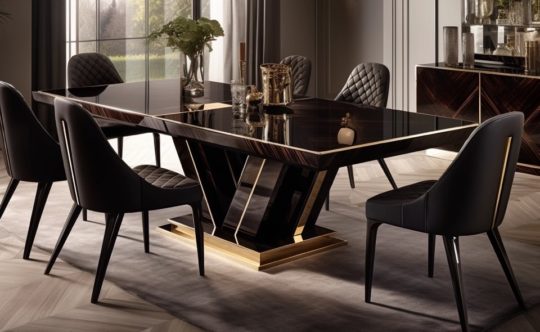
Luxury home office interior design guide
A well-designed home office has become an essential part of modern living. Whether you work remotely full-time, balance a hybrid schedule, or simply need a dedicated space for managing your household or personal projects, your home office should be more than functional. It should inspire focus, creativity, productivity and calm, while reflecting your individual style and the elegance of your home. That’s why we’ve created this comprehensive home office interior design guide. It will help you navigate the complexities of designing a high-end workspace, ensuring that every detail, from layout and furniture selection to materials and finishes, is meticulously considered to enhance both your work and your home’s aesthetic.
Creating a luxury home office that seamlessly combines elegance, comfort, and productivity requires more than selecting a desk and chair. Every element, from colour palettes and textures to bespoke furnishings and spatial flow, must work in harmony. At Juliettes Interiors, we believe that a home office is as deserving of as much design attention as any other room. From dedicated studies in luxury homes to multifunctional spaces that double as a dining room or living area, the right design elevates both productivity and lifestyle.
Jump to:
- Design inspiration
- Colour scheme
- Space planning
- Factors to be considered when planning your room layout
- Selecting the right furniture
- Selecting the right materials and finishes
- Why work with an interior designer?
- Luxury home office interior design, London, UK
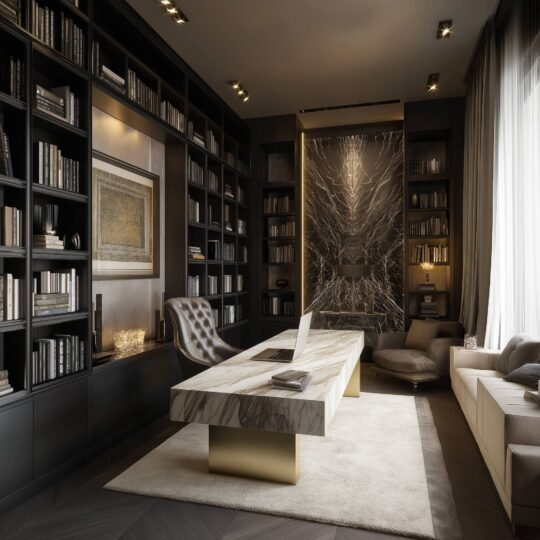
Home office design inspiration
Every great interior design project begins with inspiration. Designing your home office should start by gathering ideas and refining your vision, not just for how it will look, but for how it will feel and function. After all, a home office is more than a workspace; it’s a setting that should inspire productivity, focus, creativity, and calm, while aligning seamlessly with the aesthetic of your home.
Start by asking yourself a few key questions:
- How do I want to feel in this space—calm and contemplative, energised and creative, or professional and sophisticated?
- What activities will I use this office for—quiet focus, business meetings, creative brainstorming, or perhaps a combination?
- Will the space be mine alone, or shared with a partner, children, or guests?
Answering these will help you define the foundations of your design vision.
Creating mood boards is an excellent way to curate and organise your inspirations. Collect visuals that embody the atmosphere you want to create, whether it’s an executive-style study with rich, dark tones or a serene creative space flooded with light and calming hues.
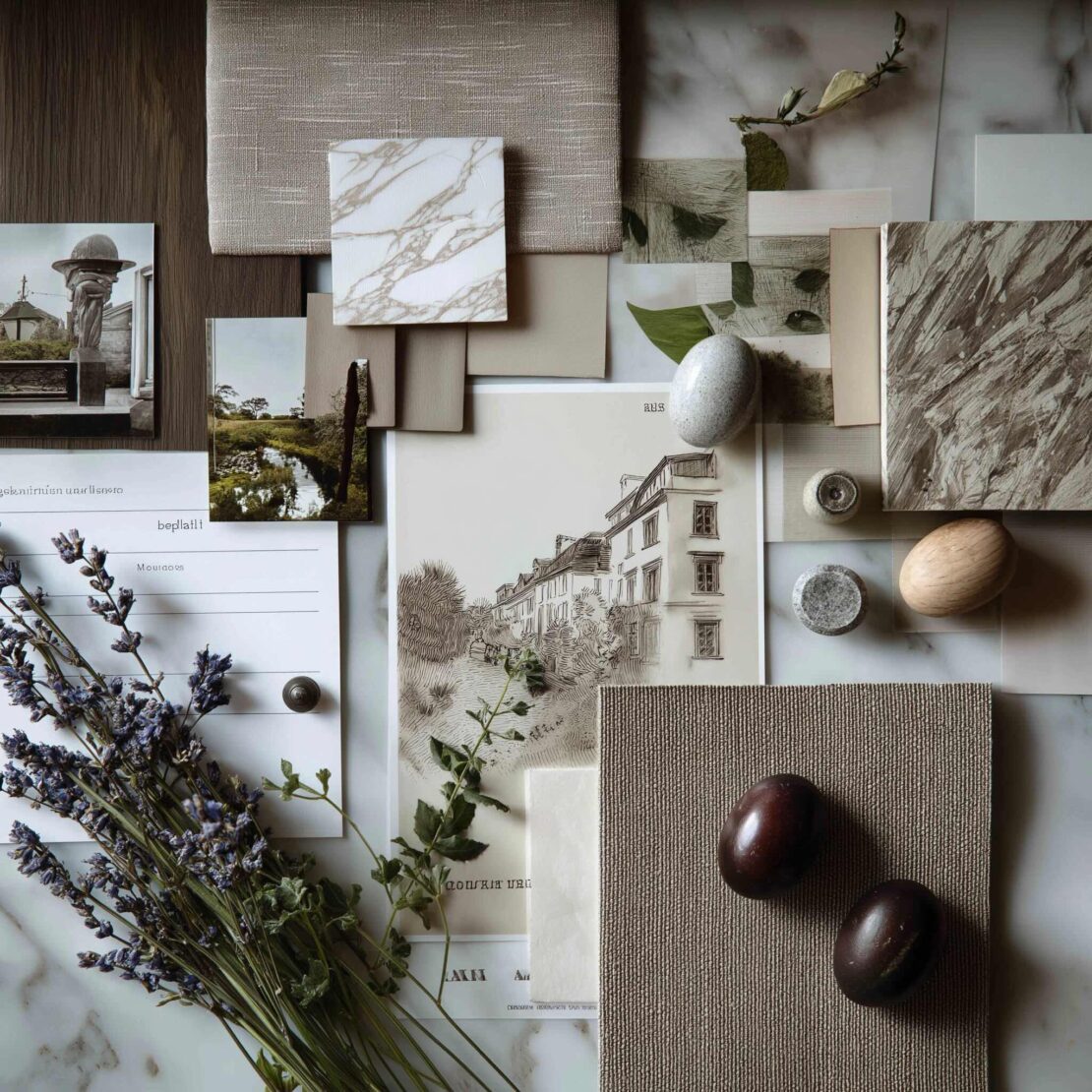
When gathering inspiration, consider these four key elements:
- Colour: Identify tones that encourage the mood you want to cultivate—whether it’s calm, focus, or energy
- Texture: Incorporate ideas for tactile richness, from upholstery to desk finishes, that will bring depth to the space
- Material: Think about the luxury finishes you want to introduce, from marble desktops to fine woods or brushed metals
- Mood: Capture the overall atmosphere—professional and sophisticated, relaxed and creative, or somewhere in between
Whether you use digital tools like Pinterest or prefer the tactile approach of physical boards, this process will help you visualise your design and refine your ideas into a cohesive direction.
When collaborating with an interior designer, mood-boarding and visioning sessions are an invaluable step. They help translate the images in your mind into a clear design brief, ensuring that every detail supports both your lifestyle and your work.
Expert tip: Think beyond interior images when gathering inspiration. Abstract imagery, haute couture fashion, or natural landscapes can often spark more original and creative directions, helping convey the essence of your desired ambience, than limiting yourself to existing home office images.
Colour scheme
A well-considered colour scheme is essential to creating the perfect atmosphere in your home office. Colour doesn’t just shape the aesthetic; it influences your mood, focus, and overall productivity. Understanding the four elements of colour theory will help you refine your palette:
- Hue – colour at full saturation
- Tint – adding white to a colour
- Tone – adding grey to a colour
- Shade – adding black to a colour
The way colours interact with one another can have powerful effects. For instance, pairing darker tones next to lighter ones will make the lighter hues appear brighter, while warm tones placed beside cooler shades will enhance each other’s qualities. In a home office, these effects can be used strategically—think bright accents to energise, paired with calming neutrals to maintain balance.
Colour harmonies for home offices
When selecting your colour scheme, consider these eight key colour theories to create a harmonious and refined palette:
- Monochromatic – different shades, tones, and tints of a single colour create a clean, cohesive look—ideal for serene, minimalist offices
- Analogous – three colours adjacent on the wheel deliver harmony and flow, perfect for calm, balanced environments
- Complementary – opposite colours such as blue and orange offer dynamic contrast, energising the room—best used in moderation for focus spaces
- Split Complementary – two hues flanking a complementary colour provide boldness without overwhelming—ideal for creative home offices
- Triadic – three evenly spaced colours create vibrancy and balance; softer shades suit shared offices or multi-functional spaces
- Achromatic – black, white, and greys create timeless sophistication, particularly when layered with textures and luxe finishes
- Tetrad – four complementary colours offer richness and complexity, requiring careful balance to avoid overstimulation
- Square – four colours equally spaced for vibrancy and balance, best used with softened tones to maintain professionalism
Colour psychology in a home office
The right colour palette can transform your office into a sanctuary of calm, a hub of productivity, or a centre of creativity, depending on your needs:
- For focus and clarity: Shades of blue are proven to enhance concentration, while greens reduce eye strain and foster a sense of balance.
- For calm and quiet: Soft neutrals, muted greys, and off-whites create a serene, contemplative backdrop—ideal for long workdays or study.
- For creativity and energy: Accents of yellow, orange, or coral stimulate optimism and inspiration, perfect for brainstorming or artistic roles.
- For gravitas and professionalism: Deep tones such as charcoal, navy, or forest green exude authority and sophistication, ideal for executive-style studies or spaces used for client meetings.
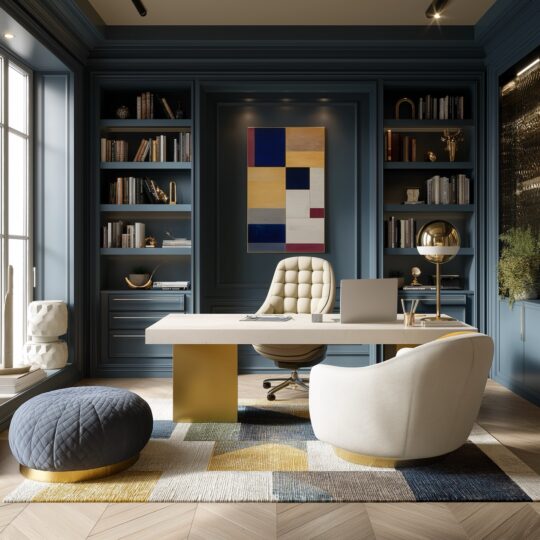
A carefully chosen colour scheme doesn’t just enhance aesthetics, it shapes how you experience your home office every day. Whether you’re designing a dedicated study, a multifunctional dining-office hybrid, or a shared space for the whole family, colour is the foundation that ensures the room supports your goals and lifestyle.
Expert tip: Always test colours in the room they’ll be used. Natural and artificial light can dramatically change how shades appear throughout the day, which is especially important in a workspace you’ll use at varying times.
For a deeper dive into how colour affects mood, perception of space, and design cohesion, explore our Colour Theory for Interior Design Guide.
Space planning for your home office layout
Space planning is the cornerstone of successful home office interior design. To create a luxury office that feels both functional and elegant, every detail must be carefully considered—from the position of your desk to how the space flows and adapts to different uses. This is where the expertise of an interior designer becomes invaluable. With thoughtful planning, your home office can move beyond being a simple, functional workspace to become a hub of innovation and motivation.
Defining the purpose and uses of your home office
Start by asking: What is the primary function of this home office, and what other uses must it accommodate?
- Dedicated studies: A private retreat designed exclusively for work or study.
- Multifunctional spaces: Offices that double as dining rooms, living areas, or guest rooms.
- Shared offices: Spaces used by two professionals, or flexibly by parents during the day and children after school.
- Client-facing offices: Rooms designed to host meetings or video calls, where professional backdrops and flow matter as much as comfort.
Understanding how many people will use the office, their ages, and their needs will directly inform layout, furniture sizing, circulation, and lighting requirements.
Expert tip: Always design with your future needs in mind. If your work habits evolve, or your family grows into the space, your office should adapt seamlessly without needing a complete redesign
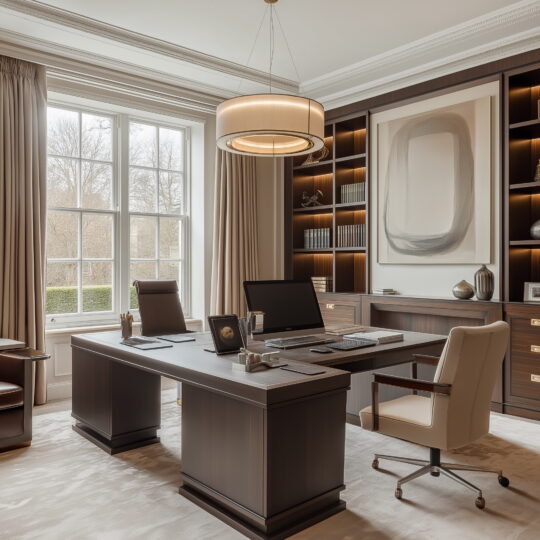
Don’t overlook less obvious areas to have your home office
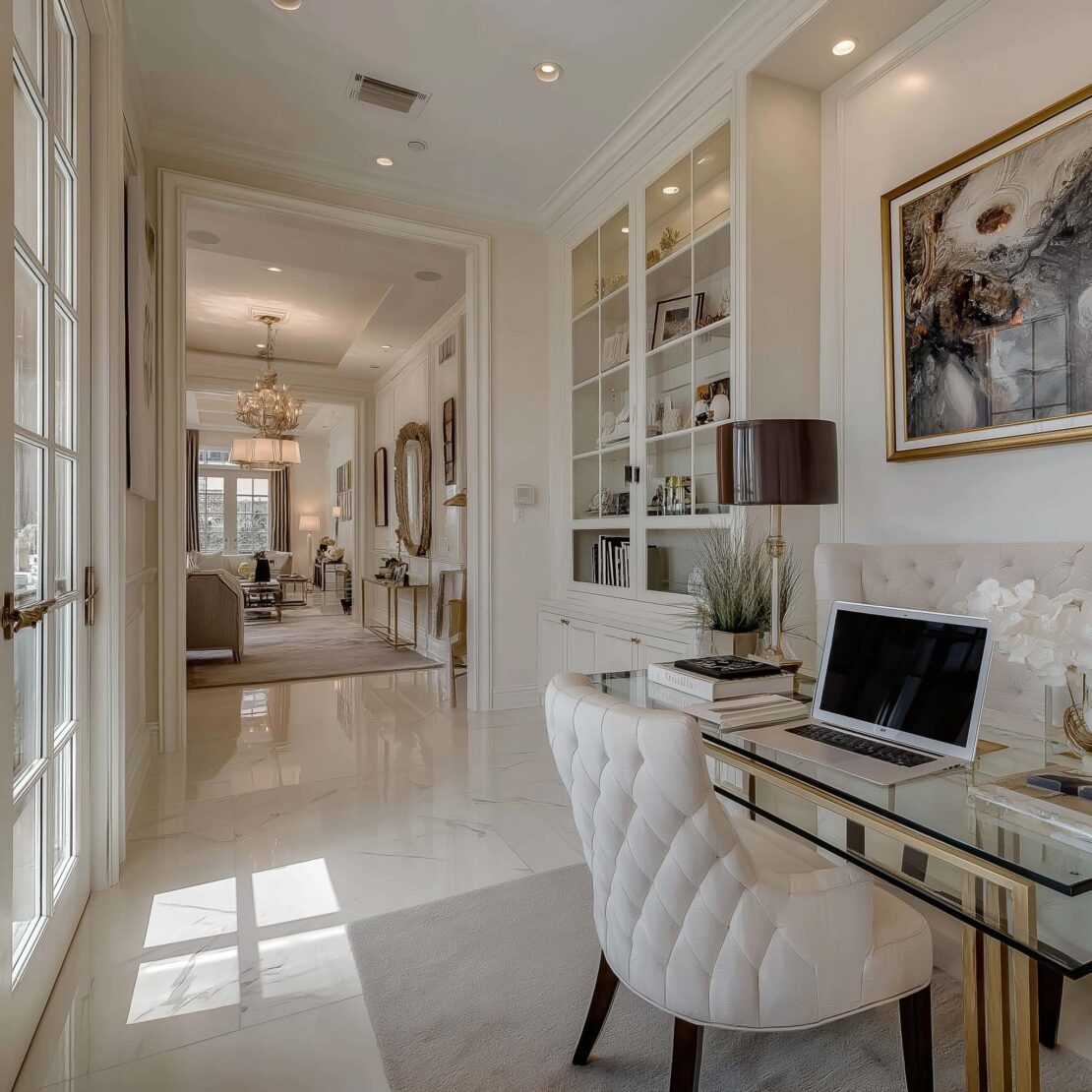
For many, a dedicated room is the ideal solution for a home office, but that isn’t always possible. Multifunctional spaces—such as living rooms, dining areas, or kitchens—can also double as stylish and efficient work zones, with the right interior design and planning. And they are part of the norm these days. But don’t overlook less obvious areas: a landing, under-stair alcove, or even a wide hallway can be transformed into a practical workspace.
One elegant approach is to create a recessed office niche. Built into a chimney breast, alcove, or wall cavity, this solution allows bookcases, cabinets, and a desktop to sit flush within the space, blending seamlessly into the architecture. The result is a tailored, proportioned workstation that feels intentional rather than improvised—ideal for high-end homes where design continuity matters as much as functionality.
Key considerations for your home office layout
Fixed architectural features
Windows, doors, built-in cabinetry, or architectural details (like alcoves or fireplaces) set the boundaries of your design. These features influence desk placement, circulation, and where storage can be positioned without disrupting flow.
Focal points
Every luxury home office benefits from a visual anchor. This could be a statement desk positioned centrally, floor-to-ceiling windows framing a view, or bespoke shelving filled with curated books and objects. If the room lacks a natural focal point, it can be created with artwork, lighting, or a feature wall.
Natural light
Lighting plays a critical role in productivity. Ideally, position your desk near a window for daylight exposure, while avoiding direct glare. Consider how sunlight moves through the room throughout the day, especially important if you use the space at different times. Layer with task lighting and accent lights for balance (see our Lighting Design Guide for more lighting design tips).
Flow and circulation
Ensure at least 90cm of clearance around key furniture for ease of movement. In multifunctional rooms, zoning is crucial—use dividers, rugs, or furniture placement to subtly separate work from relaxation or family areas.
Privacy and acoustics
For offices that double as meeting spaces, or if more than one person uses the office at the same time, consider acoustic treatments or partitions to reduce noise transfer. Screens and panels can also serve as decorative backdrops for video calls. If collaboration is required at times and privacy at others, consider moveable room dividers as an option.
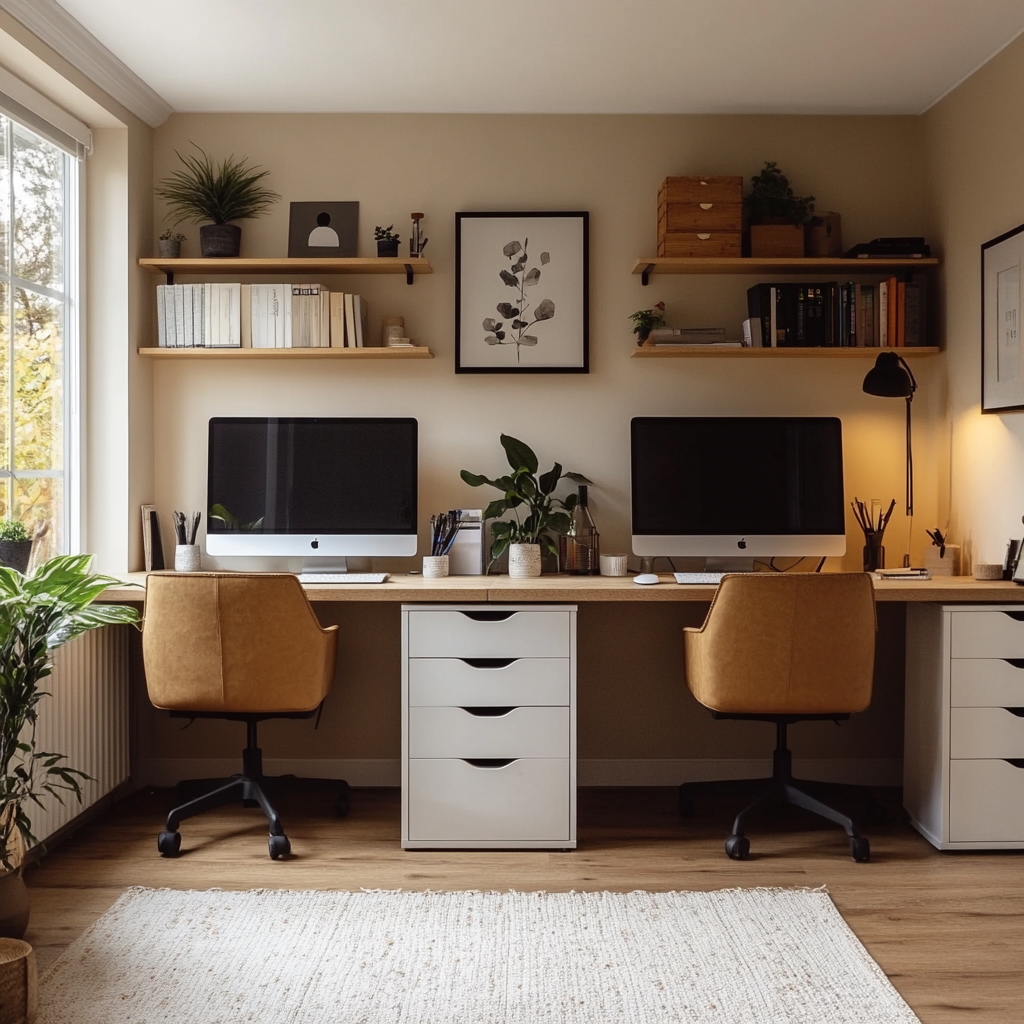
Shared workspaces
If two people share an office, dual desks, back-to-back arrangements, or custom modular designs can ensure both functionality, privacy and personalisation. Proportion and symmetry become key here, balancing two workstations without overwhelming the space.
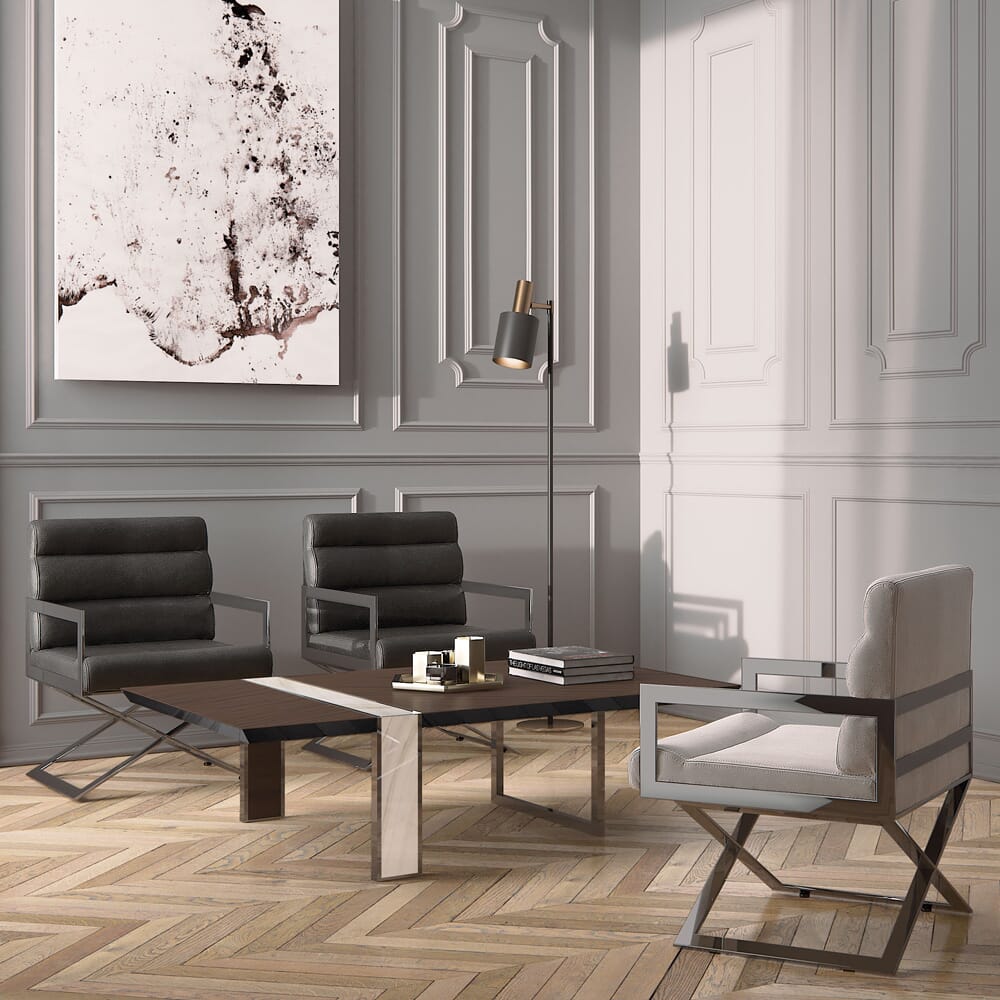
Meeting space
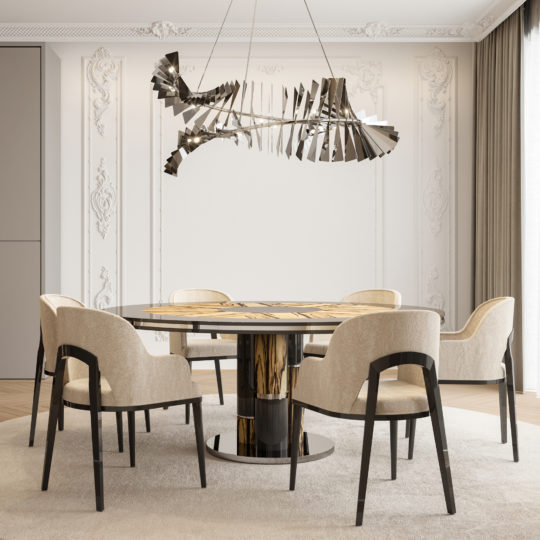
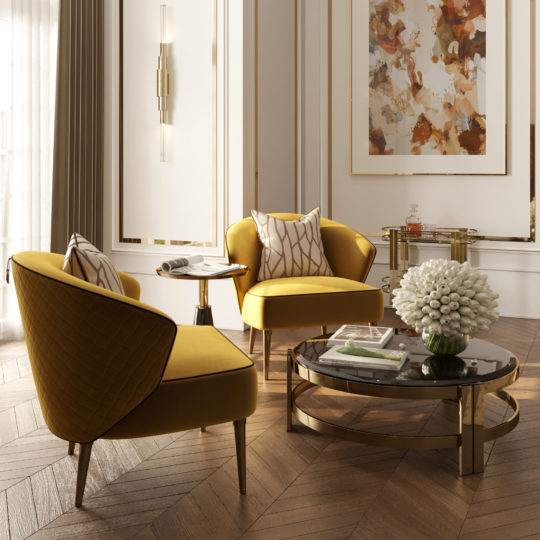
Will you host clients, colleagues, or business partners in your office? If so, consider incorporating a separate seating area into your home office design for collaboration and discussion. This prevents guests from balancing laptops on their knees or perching at the end of your desk. A round table with chairs or a pair of armchairs with side tables creates a more inviting, professional environment for brainstorming and working together.
Video meetings and presentations
With hybrid and remote working, video calls are often as important as in-person meetings. Consider how your office layout supports this:
- Do you need a wall-mounted screen for presentations, visible to you and guests?
- Is the screen free from glare at different times of day?
- What backdrop will appear behind you on camera, and does it reflect the professionalism of your role and home?
Factoring in technology and visual composition at the planning stage ensures your space is equally suited to digital and in-person business interactions.
Expert tip: If your home office doubles as a professional meeting space, treat it like a boutique boardroom. Incorporating a secondary seating or presentation zone elevates your authority and ensures both in-person and online interactions are as polished as your design.
Practical steps in planning
Getting the layout right isn’t just about where to place your desk—it’s about proportion, clearances, and anticipating how the space will function day-to-day. This is where even the most luxurious home offices can fall short, if technical details are overlooked.
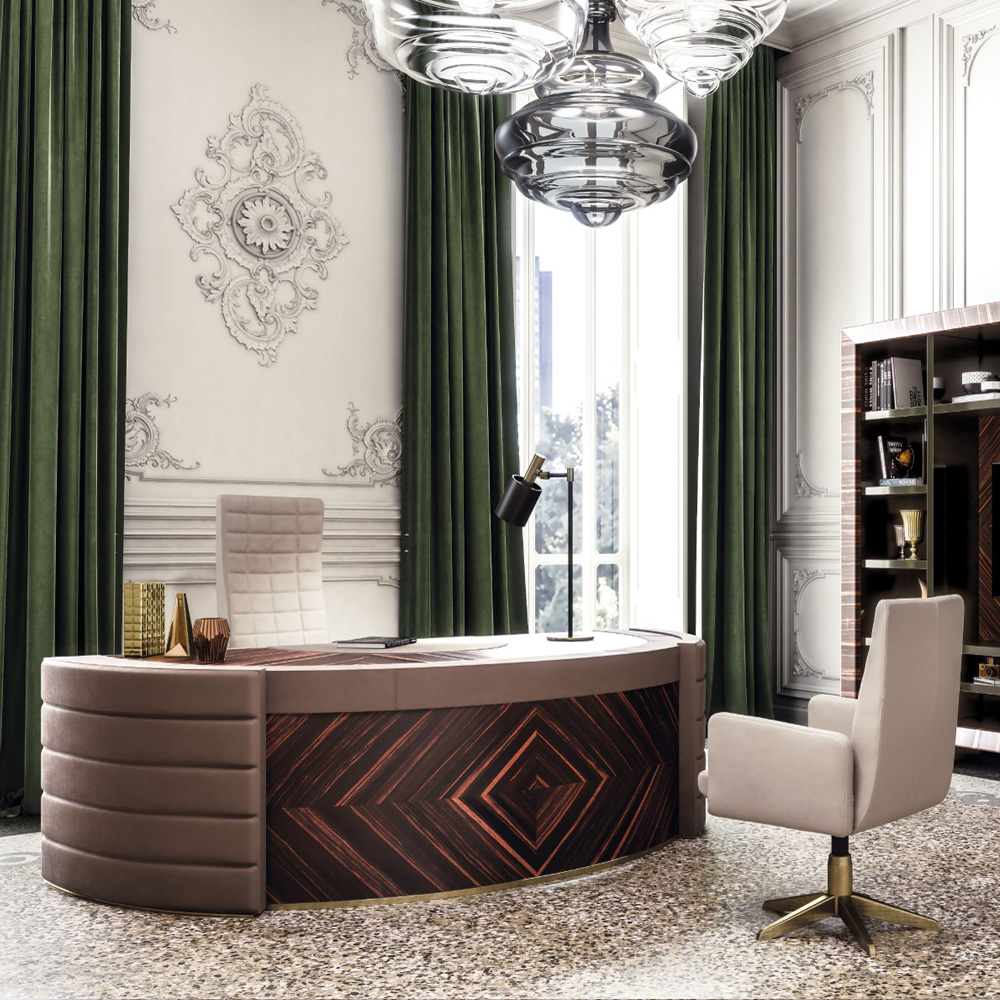
Desk placement
- Ideally, position near natural light, considering the direction of strong sunlight, facing into direct light can cause discomfort, and facing away from direct sunlight, which causes glare on screens
- Position your desk to provide a professional backdrop for virtual meetings
- Always allow at least 90cm clearance behind your office chair to move freely, too often overlooked in tight spaces
- Avoid placing your desk with your back to a door, as this may create discomfort and can appear unprofessional on video calls if people come in and out behind you
Storage
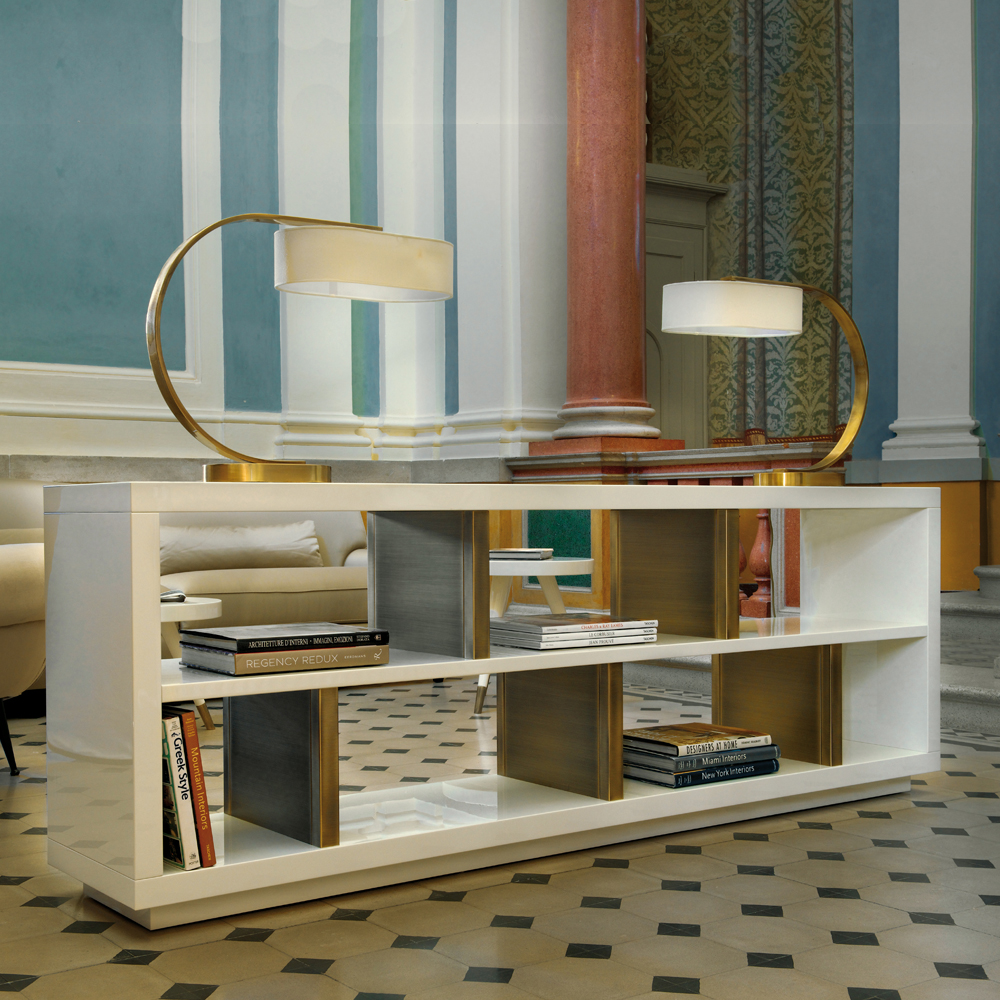
When designing a home office, storage should be part of the plan from the very beginning, not an afterthought. Take time to evaluate exactly what your workspace will need to accommodate: from files, reference books, and stationery to printers, chargers, or personal collections you want on display. Mapping this out early ensures your storage is seamlessly integrated into the overall design rather than feeling pieced together later.
A frequent home office interior design mistake is underestimating how much storage you’ll actually need. Over time, paperwork, supplies, and equipment tend to accumulate, and without enough capacity, even the most elegant office can quickly feel cluttered. Building in more storage than you think you require gives your space longevity, adaptability, and a consistently refined appearance.
- Built-in cabinetry could be designed to the exact scale of the room
- Think vertically: bespoke shelving that rises to ceiling height maximises storage while creating visual grandeur
- Low bookcases or storage options can act as a divider in multiple-person home offices, but still allow communication and creative flow between desks
- Open or closed storage, do you have beautiful leather-bound books to display, or are the items you’ll be storing better hidden?
Meeting areas
- For a secondary seating zone, leave at least 1m of circulation around chairs and tables for comfort and accessibility
- Use round or oval tables for collaborative meetings; rectangular ones can feel formal and hierarchical, which may not suit a home environment
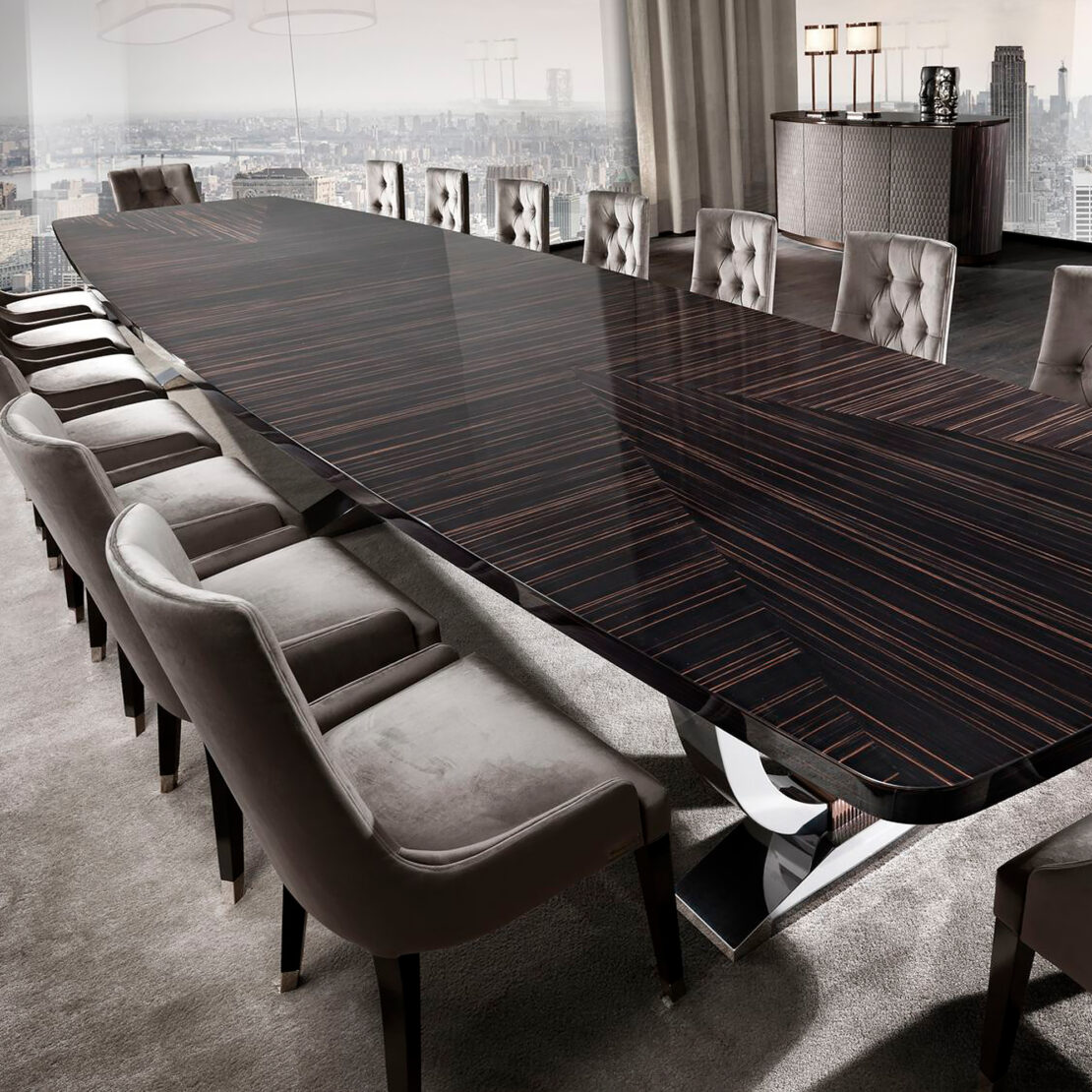
- For more formal meetings, a board table may be the best option. You can easily work from a board table day to day, but also seat a number of colleagues or clients more formally as required
- A frequent interior design mistake is positioning seating too close to the main workstation; ensure it feels like a defined, separate zone rather than an afterthought
Technology integration
- If wall-mounting a screen, the centre should sit at roughly eye level when seated (around 105–110cm from the floor)
- Avoid placing screens opposite windows—reflections will render them unusable
- Hide cables and routers within bespoke cabinetry; visible wires instantly break the illusion of luxury
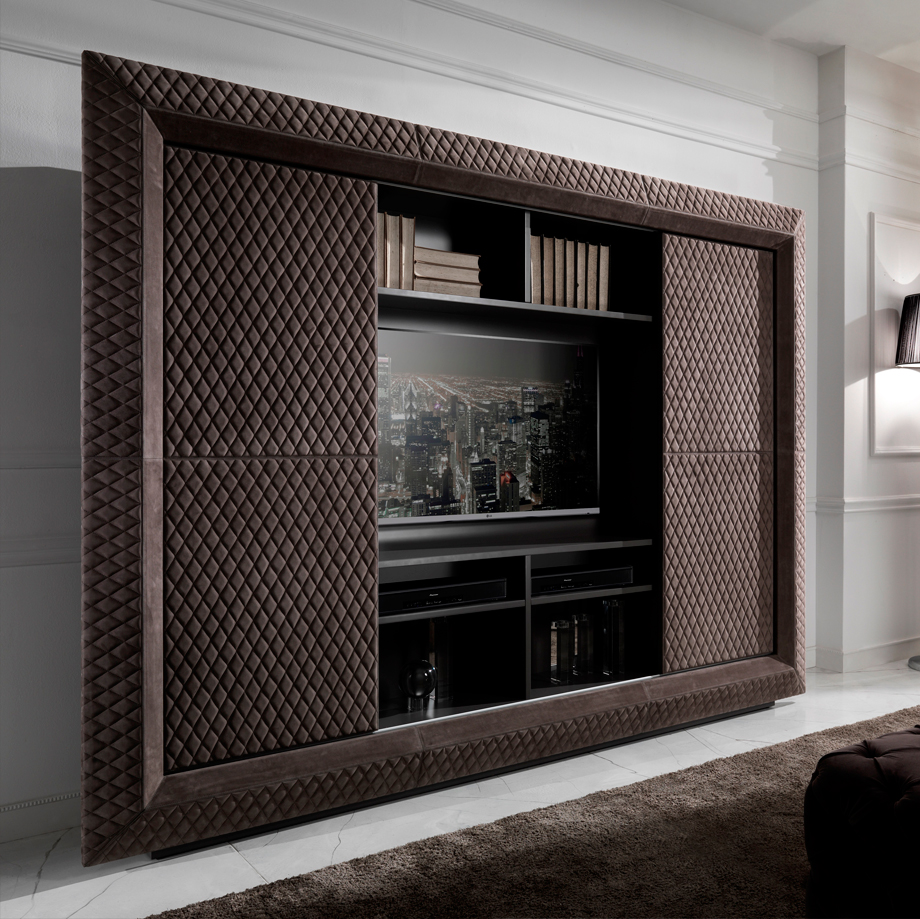
- Consider a sliding cabinet that allows you to hide the screen away
Multifunctional room solutions
- In hybrid rooms, foldaway desks should be flush when closed, not projecting into the space
- Dividers or sliding panels can be used to “disappear” the office when it’s time to transition back into living or dining mode
- The biggest mistake? Trying to force a full office set-up into a multifunctional room without zoning—it leads to cluttered, confused spaces
Expert tip: As part of the home office design process, always test circulation paths in your floor plan. Imagine walking from the entrance to your desk, to storage, and to a meeting area—if anything feels cramped or awkward on paper, it will feel even more so in reality.
Existing home office furniture
Unless you’re starting with a completely blank canvas, you may already have home office furniture that needs to be incorporated into your new design. This could be a cherished antique desk, a high-performance ergonomic chair, or bespoke cabinetry that you’ve invested in previously. The key is to ensure these pieces integrate seamlessly into your updated layout and overall aesthetic.
Using a measured floor plan and experimenting with different arrangements, either on paper or digitally, can help you visualise how existing furniture fits within the new scheme. Once you’ve narrowed down one or two layout options, map out the key zones of your office: desk placement, storage areas, and any meeting or seating zones. This process ensures your existing pieces are accounted for before new elements are introduced.
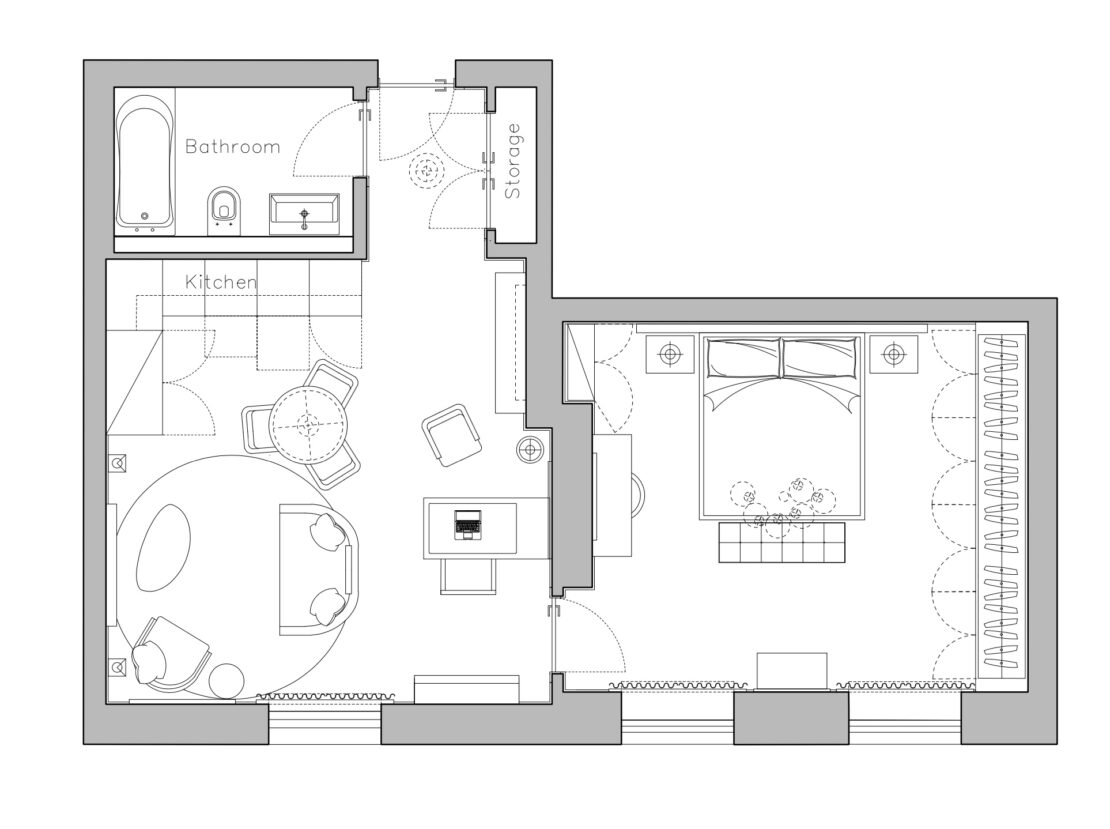
At this early stage, you most likely haven’t finalised all of your future selections, so exact sizes for new pieces might not be known. For furniture you plan to keep, however, be as precise as possible with dimensions. For anything new, allocate rough measurements based on standard desks, chairs, or storage units. With these in place on your floor plan, you can test circulation routes to identify pinch points, visual imbalances, or practical challenges before committing to a design.
A common mistake is attempting to force ill-fitting pieces into a space simply because they already exist. An interior designer can help you assess whether a much-loved item should remain as-is, be adapted (through refinishing or reupholstery), or be replaced with a bespoke alternative that better suits the proportions of the room. This expert input ensures your office feels cohesive, functional, and luxurious—without compromising on comfort or personal sentiment.
Selecting the right home office furniture
When selecting your home office furniture, the following key considerations should guide your choices:
- Style and colour
- Use and user
- Size and scale
- Materials and finishes
- Cost and value
- Durability
- Comfort
- Fit for purpose
Refer back to your mood board
This is the moment to revisit the vision you established earlier in your luxury home office interior design journey. Your mood board will help refine the tone and style direction of your home office. Pay close attention to the shapes and silhouettes that dominate your inspiration—are they clean and architectural, or soft and sculptural? Do they convey a sense of weight and gravitas, or lightness and calm?
Consider how the colours and textures on your board work together—what’s the balance between grounding neutrals and energising accents? Are there tactile cues, such as leather, wood grain, or polished metal, that you want to translate into furniture selections?
To clarify your interior design direction, write down three to five descriptive words that encapsulate your vision—such as sophisticated, calming, modern, or commanding. This creates a clear framework for selecting every piece of office furniture, ensuring each one aligns with your aesthetic while enhancing the function of the space.
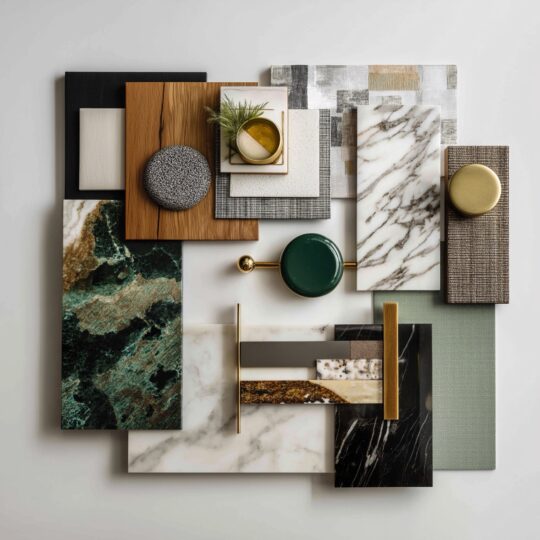
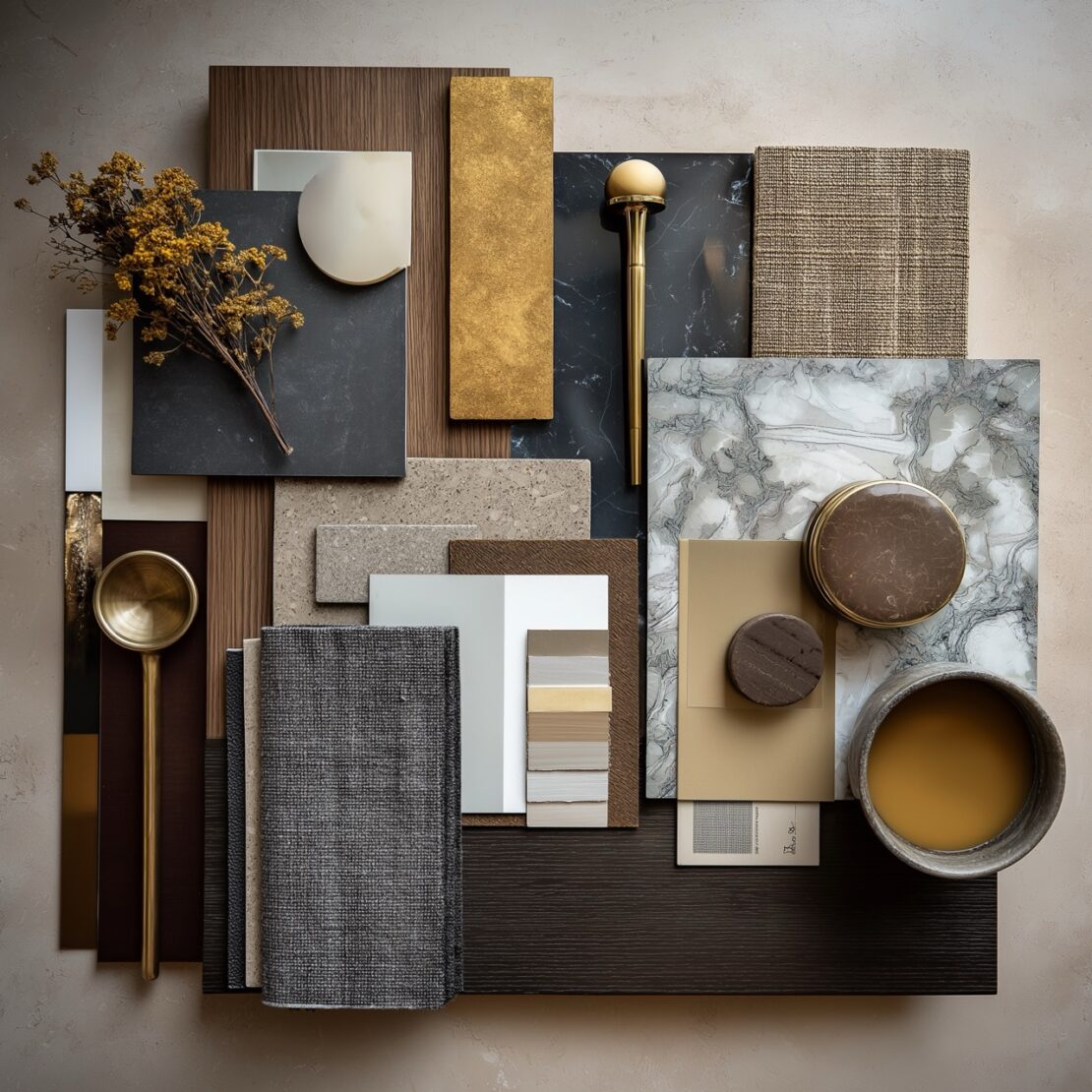
Expert tip: A physical sample board that combines wood finishes, upholstery swatches, and metal accents can be invaluable when selecting office furniture. It allows you to see how textures and materials interact in real life, ensuring harmony and refinement.
Planning for Access
While design and functionality are vital, one often-overlooked element is access. No matter how perfectly a desk or shelving unit fits into your design plan, it must also fit through the access routes of your home.
Keep in mind:
- Delivery and installation routes: Map out the path from the entranceway to your office
- Measurements: Take precise measurements of doorways, stairwells, and corridors
- Tight spaces: Factor in low ceilings, narrow hallways, or tight stair turns, particularly for large desks, bookcases, or built-in cabinetry.
Overlooking access can lead to costly mistakes. For example, a bespoke boardroom table may look perfect on paper but could be impossible to manoeuvre into the room.
Experienced interior designers will consider both the room itself and the access routes from the outset, ensuring every piece arrives and installs seamlessly.
Expert tip: If a piece seems too tight to fit or you know you have access issues, commission it in modular sections. Bespoke desks and cabinetry can be designed to assemble elegantly in situ, guaranteeing a flawless finish without compromise.
Home office interior design: Selecting the right materials and finishes
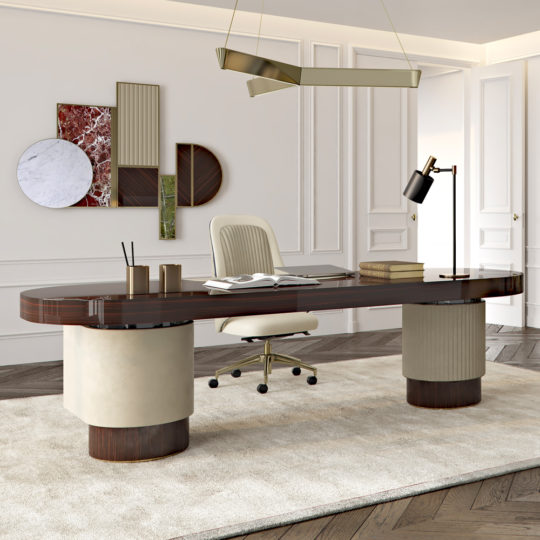
In a luxury home office, the materials and finishes you choose define not only the aesthetic but also the durability, comfort, and long-term functionality of the space. With so many possibilities, wood, stone, lacquer, leather, metals, and more—it’s important to understand the characteristics of each and how they perform in a working environment.
Below are some of the most common materials used in high-end office furniture, along with their benefits, challenges, and expert considerations.
Solid wood
Properties:
Durable, timeless, and full of natural character. Popular choices include walnut, oak, mahogany, and ebonised woods.
Benefits:
- Creates gravitas and a sense of permanence—perfect for executive-style desks or cabinetry
- Ages beautifully, developing a rich patina
- Highly versatile—works in both traditional studies and contemporary offices
- Can be custom-stained, carved, or detailed for bespoke pieces
Challenges:
- Heavy, making large desks or shelving difficult to move
- Sensitive to humidity and temperature changes
- Requires care to avoid scratches or water rings
-
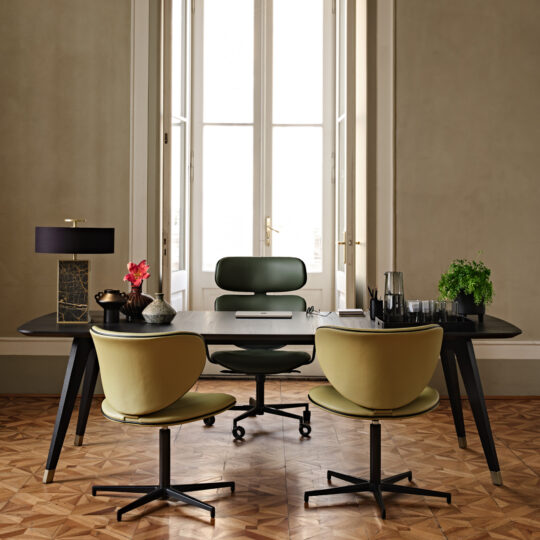
 Contemporary Rectangular Moka Ash Dining TablePrice range: £9,516.00 through £10,468.00
 -
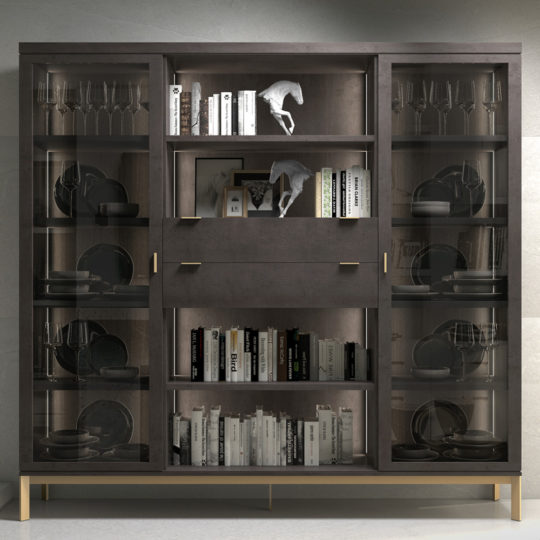
Modern Stylish Wooden Bookcase£8,869.00
-
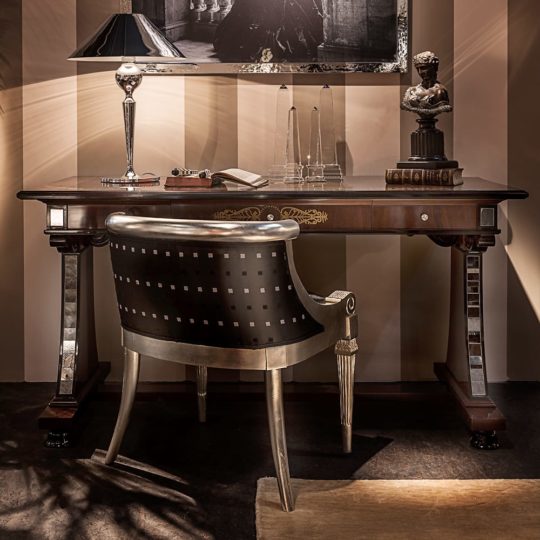
Neoclassical Mahogany Writing Desk And ChairPrice range: £4,813.00 through £18,657.00
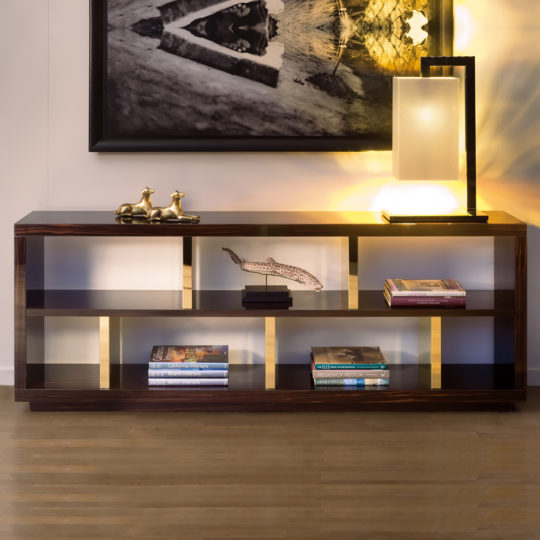
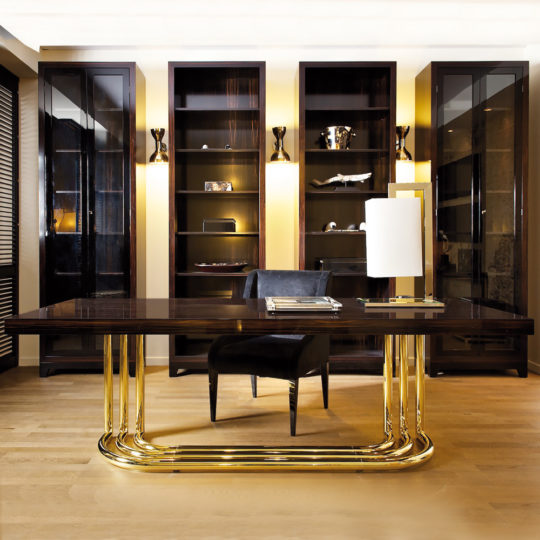
Veneered wood
Properties:
Thin slices of decorative wood are applied over a core material, often MDF or plywood. Commonly used for cabinetry, shelving, and desk surfaces.
Benefits:
- Allows for striking finishes such as book-matched grain or high-gloss lacquer
- More lightweight and resistant to warping than solid wood
- Ideal for sleek, modern designs
- High-quality veneer, when expertly crafted, can be indistinguishable from solid wood
Challenges:
- Less durable than solid wood; cannot be refinished if damaged
- Lower-quality veneers may chip or peel, so ensure you are buying high-end furniture
-
Italian Designer Ebony Veneer Writing Desk£9,467.00
-
Luxury Italian Ebony Veneered Bookcase£18,046.00
-
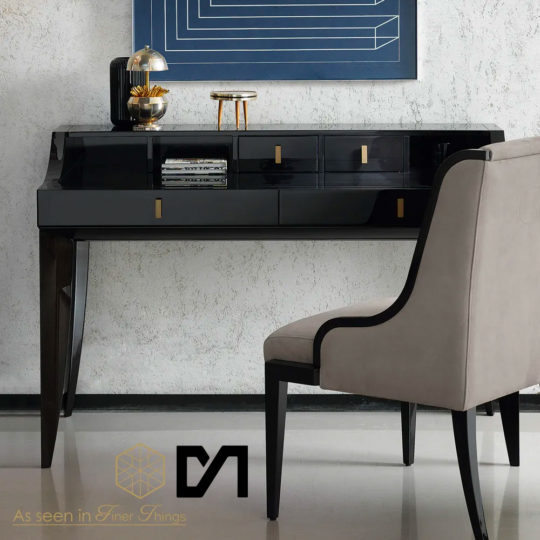
Contemporary High End Designer Writing DeskPrice range: £24,275.00 through £27,284.00
Marble and stone
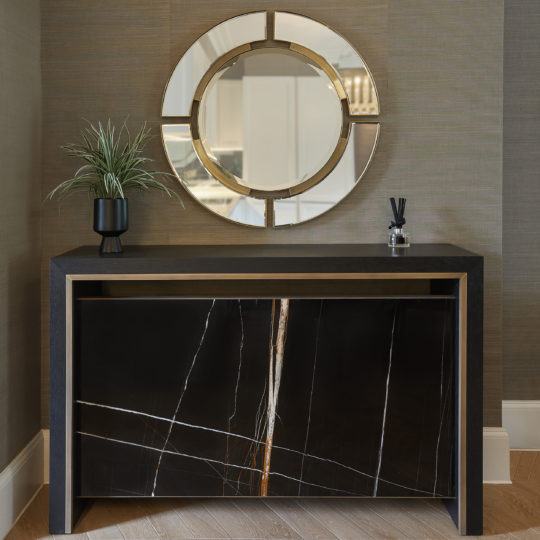
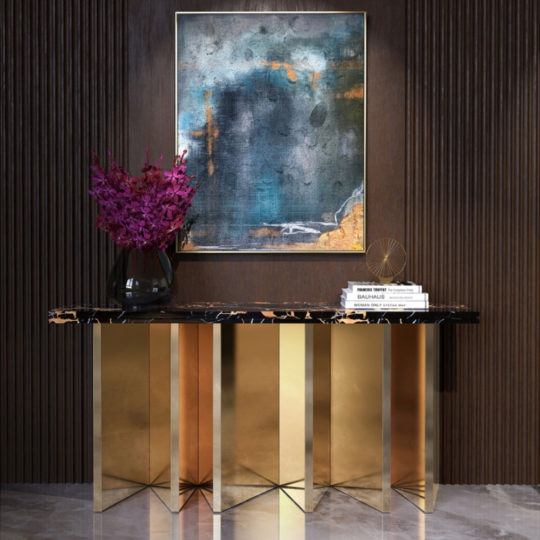
Properties:
Favoured for desktops, shelving inserts, side tables, or statement cabinetry.
Benefits:
- Unique veining and natural variation add exclusivity—no two pieces are alike
- Durable and easy to clean (with proper sealing)
- Exudes instant luxury
Challenges:
- Heavy and difficult to move
- Porous stones can stain or etch if not sealed
-
Luxury Marble Radiator Cover Console£13,776.00
-
Contemporary Marble Console£11,346.00
Metals (brass, stainless steel, bronze, chrome, blackened steel)
Properties:
Used for desk legs, handles, lighting accents, or shelving frames.
Benefits:
- Adds sophistication and structure
- Long-lasting when finished properly
- Complements other natural materials like stone or wood
Challenges:
- Certain finishes (e.g. brass) can tarnish over time
- Overuse can feel cold or clinical
-
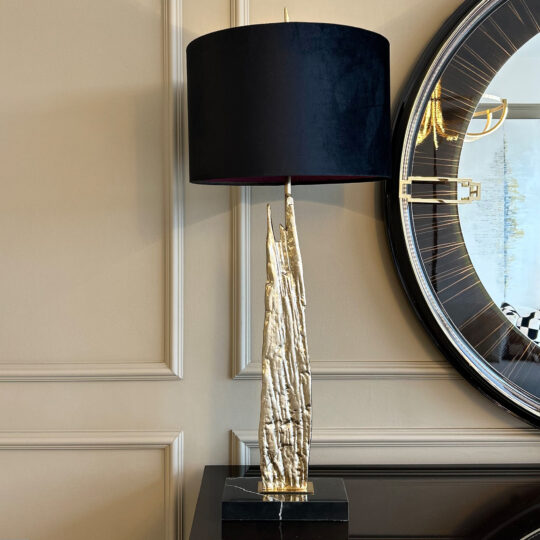
Large Abstract Table Lamp With Velvet Shade£1,015.00
-
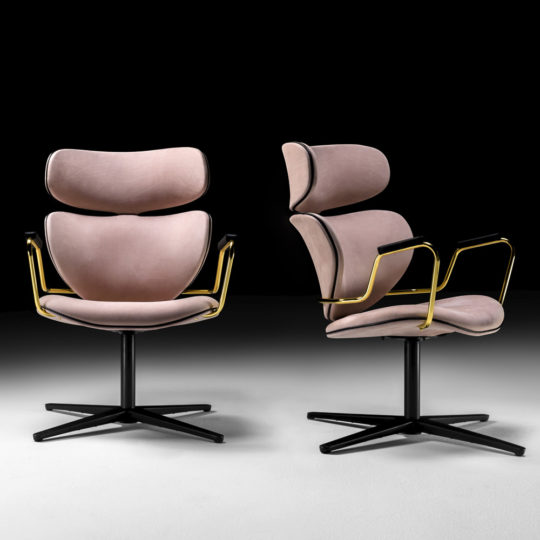
Designer Retro Leather Swivel Armchair£5,183.00
-
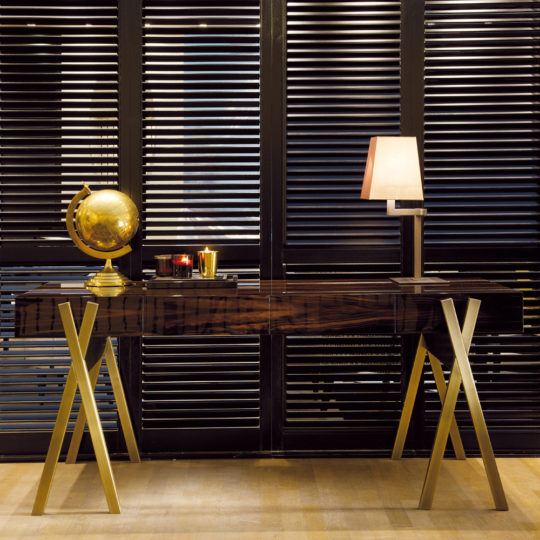
Luxury High End Italian Ebony Writing Desk£19,971.00
Glass, mirrored and high gloss finishes
Properties:
Used for desktops, shelving, cabinetry fronts, or decorative panels.
Benefits:
- Reflects light, creating a brighter and more spacious feel—ideal for smaller offices
- Easy to clean and maintain
- Pairs beautifully with wood, stone, or metal
- Use glass for shelving or cabinet doors to display curated books or art
- Mirrored accents can bring depth
Challenges:
- Prone to fingerprints and smudges
- Can feel fragile or overly modern if not balanced with warmer textures
- Avoid overuse in offices where screen glare is a concern
-
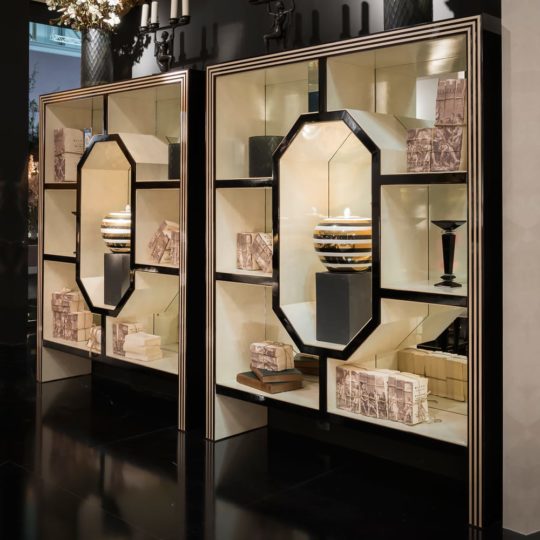
Art Deco Mirrored Bird’s Eye Maple Veneered Bookshelves£16,245.00
-
Italian Bronze Mirrored Low SideboardPrice range: £7,548.00 through £8,364.00

Mixed materials
Properties:
Combining two or more finishes (e.g. wood with brass, stone with leather, glass with lacquer).
Benefits:
- Creates richness, dimension, and a layered aesthetic
- Allows you to balance durability with refinement
- Customisable for a bespoke look
Challenges:
- Higher cost due to craftsmanship
- Requires a designer’s eye to ensure balance
Expert tip: Choose one dominant material and let the others support it—for example, a walnut desk with brass hardware and a leather inlay. This creates harmony and avoids visual overload.
-
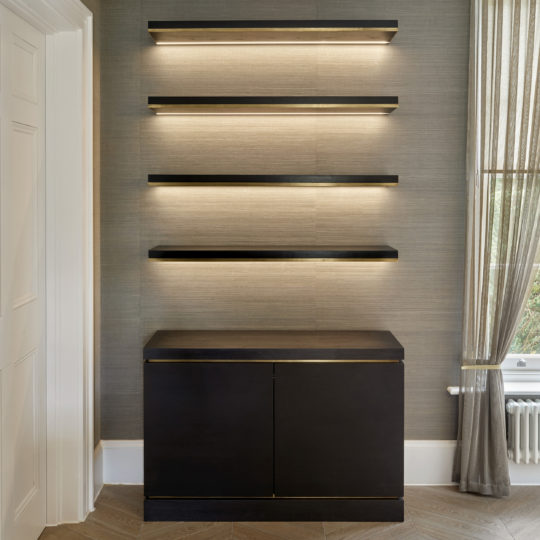
Bespoke Cabinet And Floating Shelves£13,736.00
-
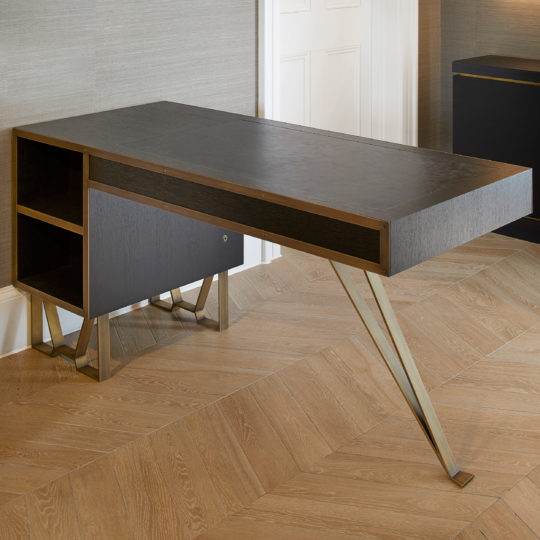
Modern Industrial Style Oak Veneer DeskPrice range: £6,206.04 through £19,336.00
-
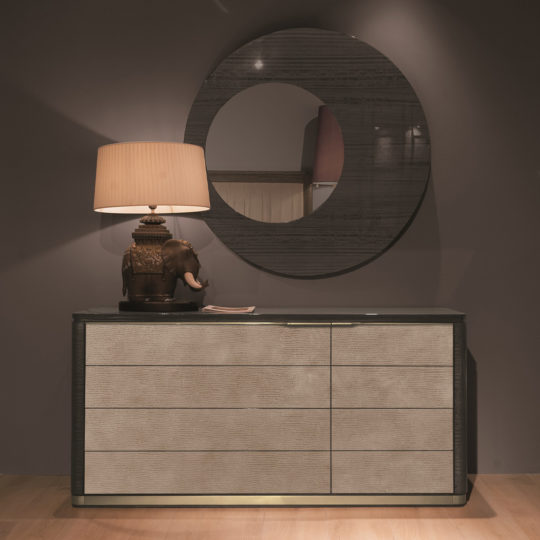
Modern Wooden Dresser And Mirror Set£8,921.00
Tips for selecting the right materials for your office furniture by function
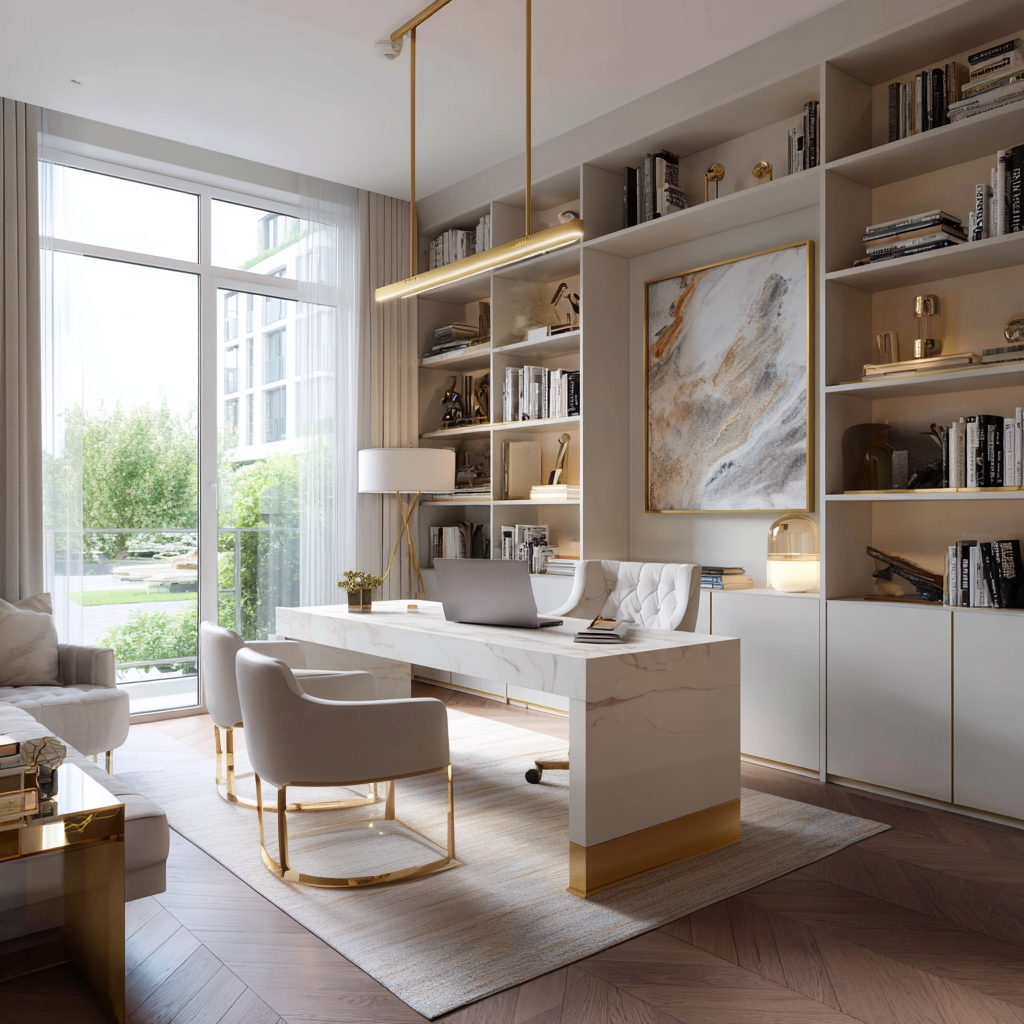
- Desk: Solid or veneered wood with stone or leather inlays for durability and refined luxury
- Storage: Veneered or lacquered cabinetry with brass or chrome detailing, complemented by stone or glass tops
- Meeting table: Marble or high-gloss lacquer for dramatic impact, balanced with upholstered chairs for comfort
- Accents: Mirrored or glass elements to reflect light and create contrast with heavier finishes
- Shelving: Solid wood or high-quality veneer, often framed with brass or metal for strength and elegance
Fabrics
Fabrics play an important role in shaping the comfort, acoustics, and overall mood of your home office. From the chair you sit in every day to the curtains that frame the light, the right choice of fabric ensures both durability and elegance.
There are two main categories of fabric to consider:
Natural fabrics (cotton, linen, silk, leather)
- Luxurious to the touch and breathable, creating a refined, comfortable atmosphere
- Develop character over time, especially leather, which gains a rich patina
- More prone to creasing and slower to dry after cleaning
Synthetic fabrics (nylon, polyester, rayon)
- Highly durable and less prone to creasing
- Quicker to dry and often more stain-resistant
- Can lack the natural texture and depth of organic fibres, so should be chosen with care for luxury environments
Another essential factor is the rub count—a measure of how resistant a fabric is to wear. In a home office, seating will require a much higher rub count than, for example, window treatments. Desk chairs, accent seating, and upholstered storage benches should be covered in fabrics designed for heavy use, while curtains, blinds, or decorative panels can prioritise texture and drape over durability.
If your home office doubles as a family or shared space, opt for performance fabrics or treated textiles that resist staining and wear. This ensures your office remains pristine and luxurious, no matter how often it’s used.
-
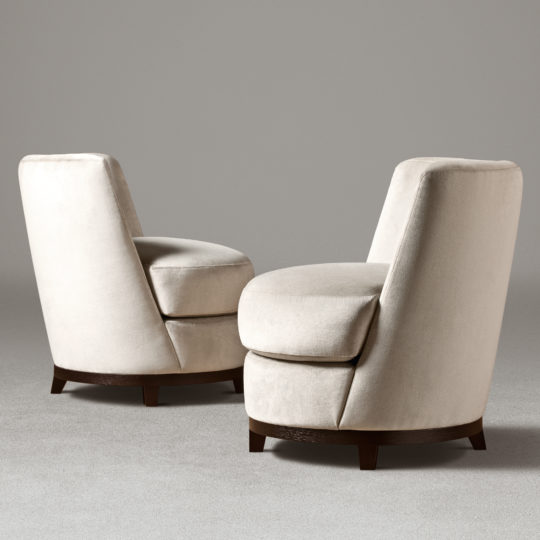
Curved Occasional Chair With Swivel BasePrice range: £6,807.00 through £8,058.96
-
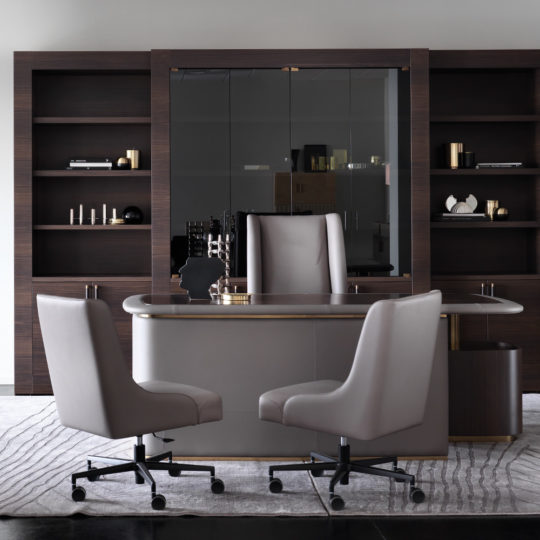
Modern Italian Designer Leather And Walnut Veneer DeskPrice range: £4,867.00 through £34,641.00
-
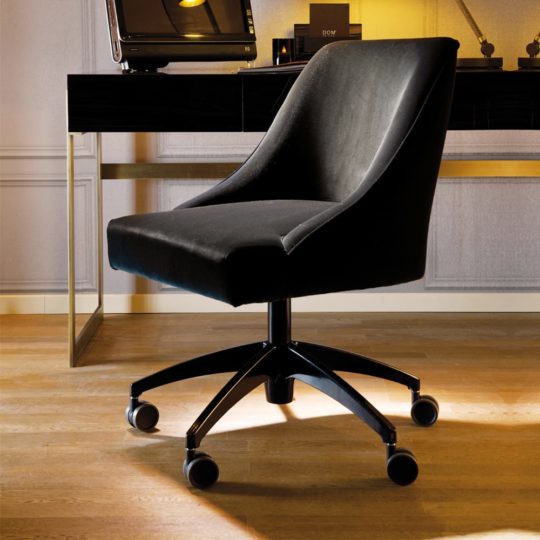
Luxury Modern Velvet Italian Office Swivel ChairCall For Price
Tips for selecting the right fabrics for your office furniture by function
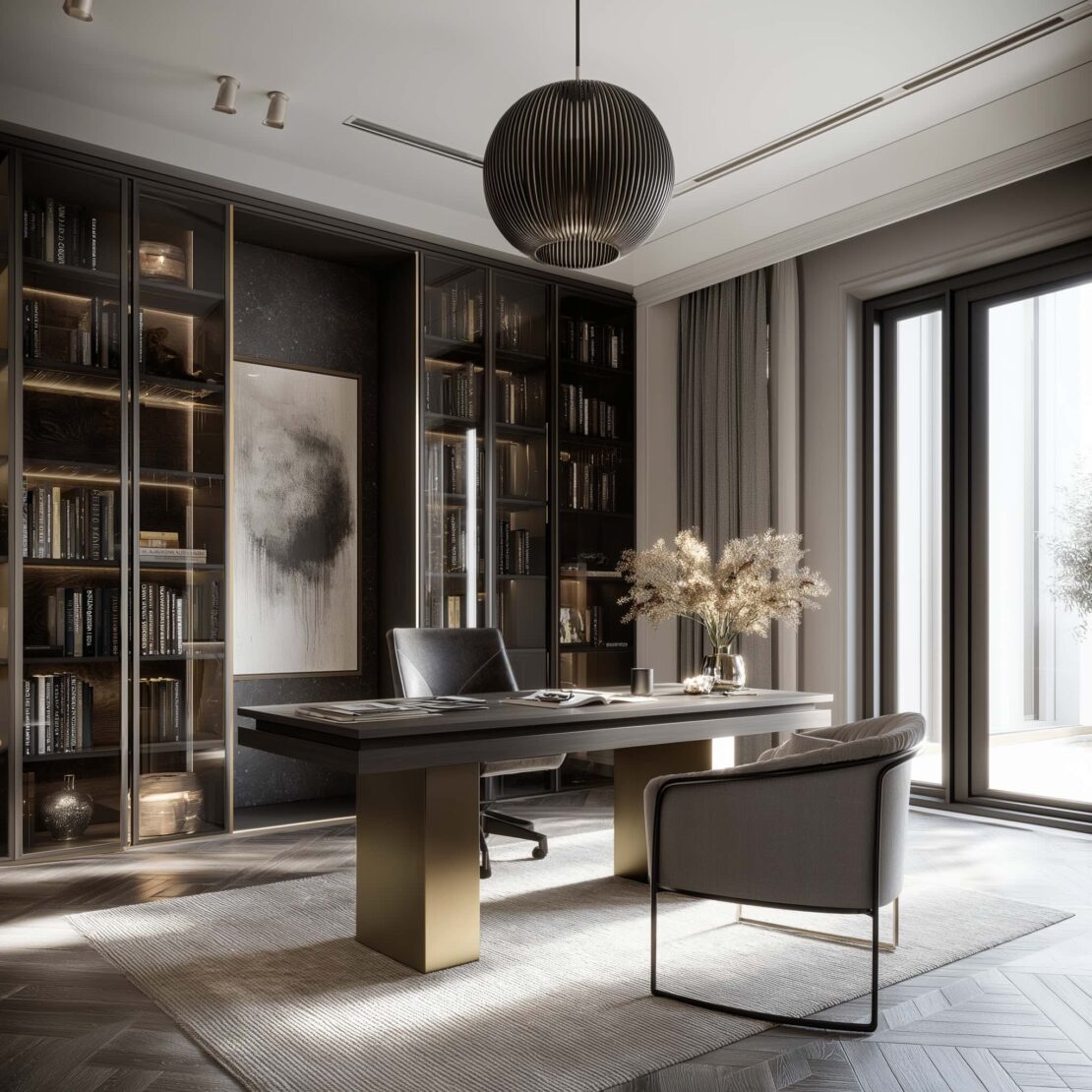
- Desk chair: High rub-count leather, performance textiles, or wool blends for comfort and durability
- Accent seating: Velvet, bouclé, or nubuck leather for tactile luxury—opt for high rub count if frequently used
- Curtains & blinds: Linen, silk, or wool for elegance; choose performance-treated fabrics for sunlit rooms
- Wall panels & screens: Upholstered in linen, suede, or acoustic fabrics to soften ambience and improve sound
- Ottomans & benches: Treated leather or stain-resistant performance fabrics to withstand daily use
Choosing the right office desk and chair
Selecting the perfect desk and office chair is one of the most important decisions in creating a luxury home office. These are the pieces you’ll use most frequently, so they must combine functionality, comfort, and refined style. Think of them as investment pieces; always opt for quality craftsmanship and materials that will stand the test of time.
Selecting the perfect home office desk
Your desk is the centrepiece of your office, both visually and functionally. Its size, placement, and design will set the tone for the entire room.
Key considerations when selecting a desk:
- Scale: A desk that is too large can dominate the room, while one that is undersized may feel inadequate for daily use. Consider the proportion alongside other furniture and the overall size of your office
- Fit and flow: Ensure there’s at least 90 cm of clearance behind and around the desk to allow for comfortable movement. Pay attention to circulation routes, especially in shared or multifunctional spaces.
- Height: Standard desks are typically 74–76 cm high. Make sure the desk height complements your height and your chair, providing ample legroom.
- Surface area: Consider your working style—do you need space for multiple monitors, design drawings, or paperwork? Or do you prefer a minimalist, clutter-free surface?
- Shape:
- Rectangular desks: Classic and versatile, offering generous workspace
- Curved or kidney-shaped desks: Ergonomic and contemporary, great for creative work
- L-shaped or corner desks: Ideal for maximising storage and separating tasks
- Bespoke designs: Tailored desks can integrate hidden storage, cable management, and unique proportions to fit your exact requirements
Standing desks and flexibility
Many prefer to stand whilst working, for some that might be most of the day, others for shorter periods. So people are looking to bring that functionality into their home offices now. Incorporating the option to work standing as well as seated into your home office design plan, this can be a height-adjustable desk or a sleek riser that elevates your existing desk surface. If you opt for a standing solution, ensure:
- There is sufficient space to move your chair aside when standing
- Technology, wiring, and screens are mounted or integrated to accommodate both positions
- You choose finishes that align with your design scheme—standing desks don’t need to feel utilitarian; bespoke designs in wood, lacquer, or stone can offer elegance alongside flexibility
-
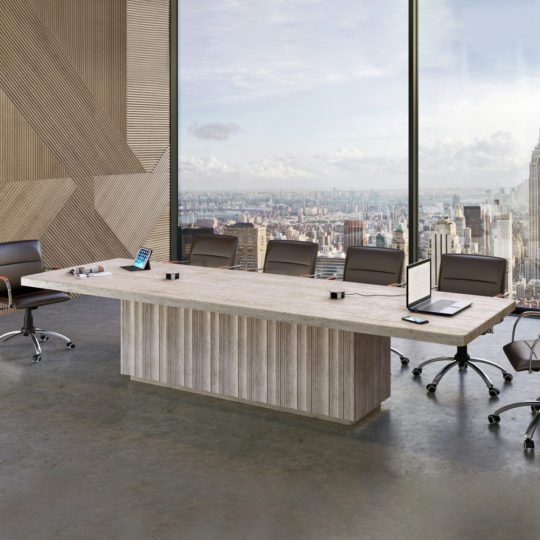
Exclusive Stone Conference TablePrice range: £64,167.00 through £72,636.96
-
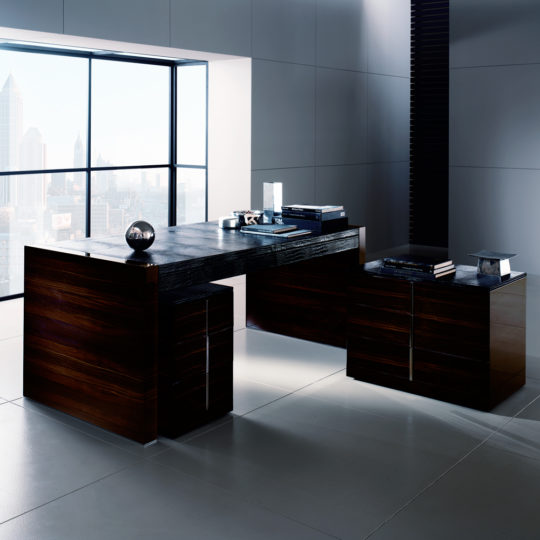
Contemporary Embossed Leather Ebony DeskPrice range: £5,215.00 through £24,810.00
Selecting the perfect office chair
Your chair is equally important as your desk, if not more so. It must be as comfortable as it is beautiful. Luxury office chairs should support long working hours in comfort without sacrificing elegance. Your office chair is the piece you’ll use most often, so the material it’s made from is as important as its ergonomics.
Key considerations when selecting a chair:
- Ergonomics: Prioritise support for posture, with adjustable height and backrests where needed. Even in luxury design, comfort must come first.
- Scale: The chair should feel proportionate to the desk and room. Oversized chairs can overwhelm smaller spaces, while slimline chairs may look underwhelming in larger offices.
- Materials:
- Leather: Sophisticated and durable, perfect for an executive office.
- Faux leather: A practical alternative that’s stain-resistant and easy to maintain. Great for multifunctional or shared spaces where durability matters more than ageing gracefully.
- Velvet or bouclé: Adds softness and tactile richness.
- Performance fabrics: Engineered for high wear, these include stain-resistant velvets, bouclé, or other luxury finishes. Ideal for family offices or multifunctional workspaces where both style and resilience are required.
- Fabric upholstery: Cotton, linen, and wool blends offer comfort and versatility, with a tactile, natural finish. Wool blends are especially durable.
- Mesh: A modern, breathable choice designed for long hours at a desk. Extremely supportive but less luxurious in appearance—best paired with more tactile accent seating to soften the look.
- Style tone:
- Executive office: Full-grain leather for timeless authority.
- Creative studio: Velvet or bouclé for a tactile, design-led aesthetic.
- Multifunctional family office: Performance fabrics that combine elegance with practicality.
- Task-focused office: Mesh for ergonomics, paired with a luxe accent chair for balance.
Expert tip: Go bespoke with a made-to-measure office chair. Commissioning a custom chair allows you to tailor every detail to your exact needs—seat height matched to your desk, armrests set for comfort, upholstery chosen to suit both your style and lifestyle. A custom office chair can be created to your exact height and body measurements, ensuring the perfect seat depth, back support, and armrest position. A truly bespoke chair balances form, function, and fit, designed not just for the room but precisely for you.
-
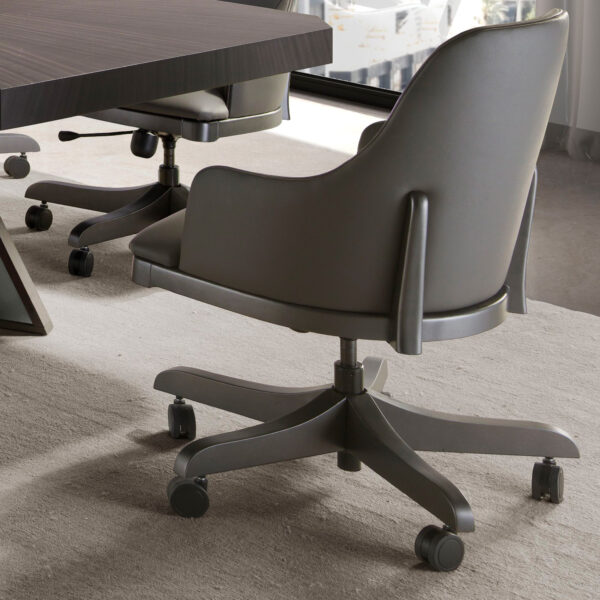
Leather Swivel Office Chair On Castors£3,733.00
-
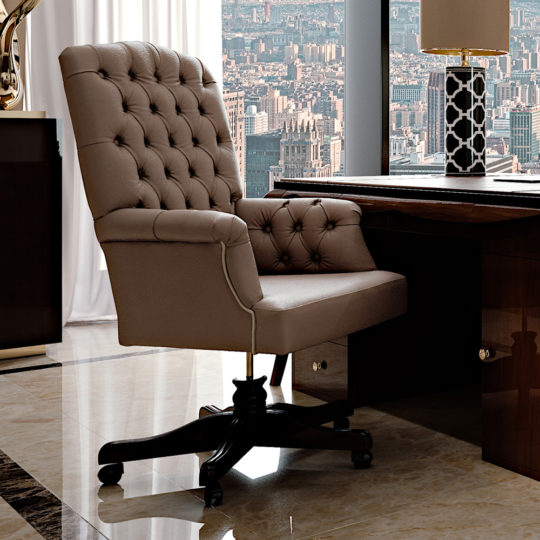
High End Italian Leather Swivel Office Chair£7,466.04
Chairs in multifunctional spaces
In many homes, the office isn’t always a dedicated room; it may share space with a dining area, living room, hallway, or guest room. In these multifunctional settings, your chair choice needs to work twice as hard, offering both comfort for long hours and aesthetic harmony with the wider space.
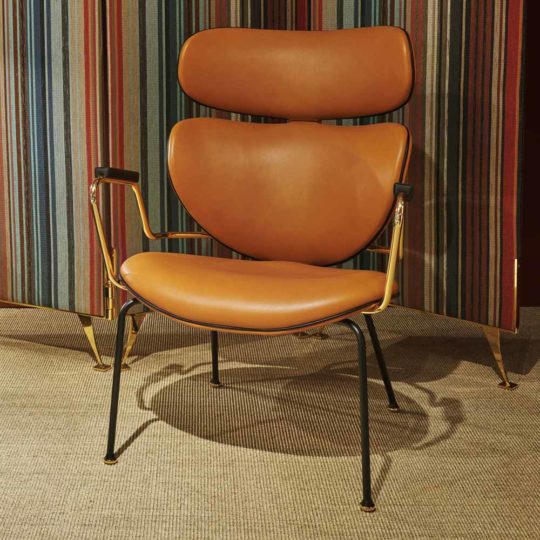
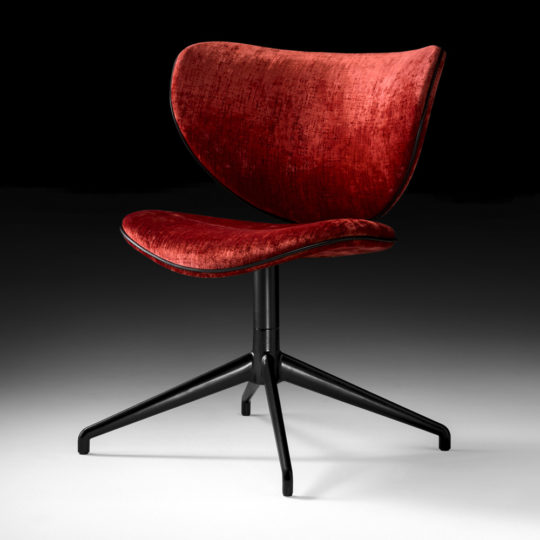
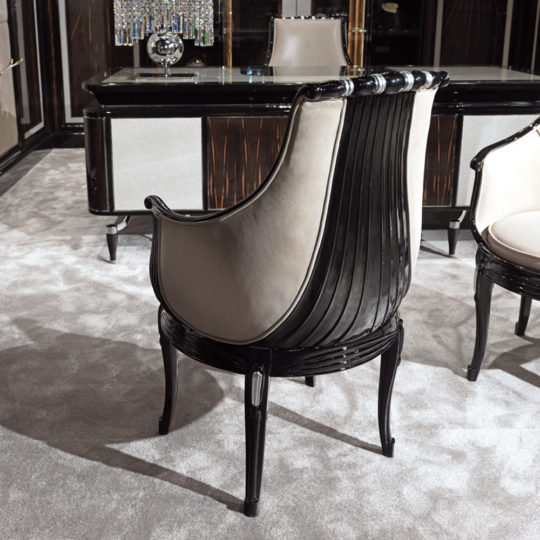
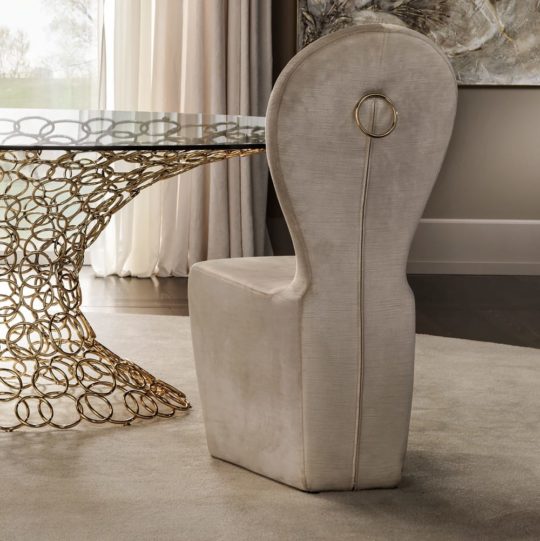
- Dual-purpose dining chairs: A well-upholstered dining chair with a supportive back can double as an office chair. Look for styles with padded seats, curved backs, and generous proportions
- Accent chairs with structure: Occasional chairs in velvet, bouclé, or leather can provide both elegance and functionality, ideal if your office is integrated into a living area
- Hybrid task chairs: Consider ergonomic chairs with slimmer silhouettes and refined finishes, making them suitable for spaces where style continuity is as important as comfort
- Portability and flexibility: Consider lighter designs or chairs on castors if your office is in a shared space. This makes it easy to tuck away or reposition the chair without compromising the flow of the room.
Expert tip: If you’re using a dining or accent chair as your office seat, add a luxury cushion or a removable lumbar pillow in a coordinating fabric. This elevates comfort while keeping the look cohesive with the rest of your interior.
Office desk and chair as a pair
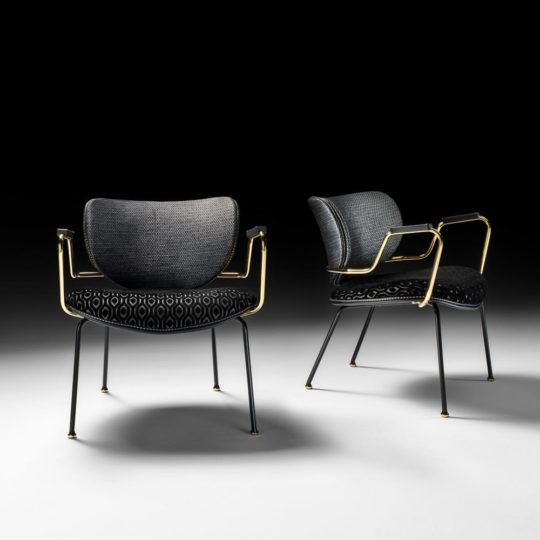
Your home office desk and chair should be considered together, not in isolation. Their proportions, finishes, and overall style must harmonise. For example:
- A substantial mahogany desk pairs well with a leather executive chair
- A sleek lacquered or marble-topped desk looks striking with a velvet or bouclé chair in a complementary shade
- In multifunctional spaces, a compact desk with a lightweight upholstered chair maintains elegance without overwhelming the room
Expert tip: Make your desk and chair fit your space, not the other way around. Bespoke, made-to-measure furniture allows you to tailor dimensions, finishes, and ergonomic details precisely to your needs—including integrated standing desk solutions—for the ultimate workspace that is both luxurious and flexible. This is where working with an experienced interior designer who specialises in bespoke furniture becomes invaluable. They’ll ensure your chair isn’t just visually striking but technically correct—balancing proportions, ergonomics, and craftsmanship. From precise specifications to the final finish, their expertise guarantees a piece that is fully functional, ergonomically supportive, and flawlessly beautiful.
Selecting the right storage options for your home office
After your desk and chair, storage is one of the most important elements of a well-designed home office. The right storage not only keeps your space organised and clutter-free but also reinforces the overall design aesthetic. Whether you choose shelving, bookcases, chests of drawers, display cabinets, sideboards or consoles, each piece should combine function with beauty.
Planning your storage needs
Before you even begin selecting furniture, it’s essential to plan your storage requirements in detail. Start by taking inventory of what you’ll need to house in your home office—files, reference books, tech equipment, stationery, display items such as awards or accolades, or personal items. This step ensures your storage solutions are tailored to your lifestyle and working habits rather than being an afterthought.
A common mistake is underestimating how much storage you’ll need. Offices naturally accumulate paperwork, cables, and equipment over time, and what feels adequate now can quickly become insufficient. Building in more storage than you initially think necessary will save frustration later and keep your workspace feeling uncluttered, elegant, and fully functional.
Key considerations when choosing or designing office storage
This is a good checklist to ensure you get your storage selection right and avoid any costly mistakes:
- Inventory first: List out everything you need to store—files, books, tech equipment, decorative objects. This ensures you design to function, not just aesthetics.
- Balance open and closed: Too much open shelving can feel cluttered; too much closed can feel sterile. The best schemes mix both for practicality and style.
- Think long-term: Build in more storage than you think you need
- Technical details: Check dimensions carefully, especially the depth of shelving and drawers. A common mistake is designing shelves too shallow for large-format books or drawers too narrow for file systems.
Size and scale
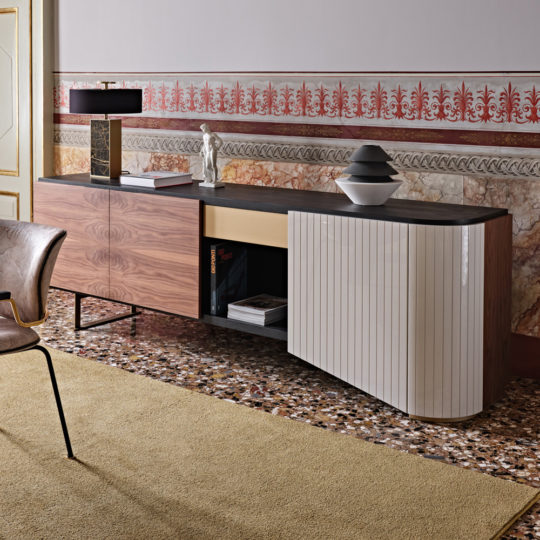
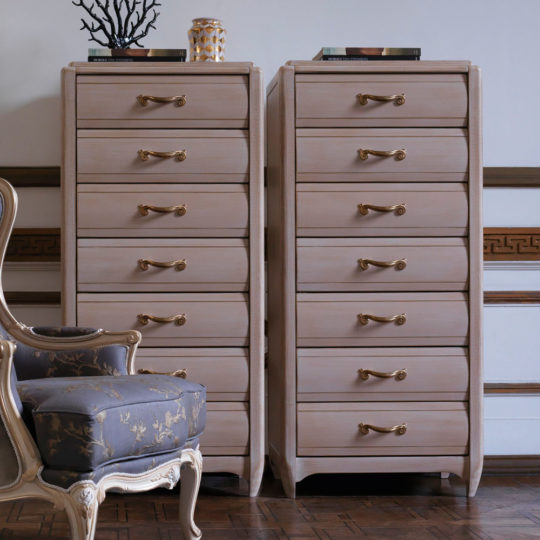
Your storage should feel in proportion to the room, large enough to accommodate everything you need, but not so imposing that it overwhelms the space. Floor-to-ceiling shelving and bookcases can create an impressive, library-style backdrop, while lower sideboards or console tables offer storage with room for decorative styling above.
-
High End Modern Canaletto Walnut Sideboard£18,606.00
-
Art Deco Inspired Console Table£6,499.00
-
Modern Elegant Wooden Bookcase£10,573.00
-
Classic Tallboy Chest Of Drawers£12,663.96


Internal layout and function
Think carefully about what you need to store day-to-day and tailor your storage accordingly:
- Open shelving for books, decorative objects, or reference materials
- Concealed cupboards or drawers for files, stationery, or equipment you’d rather keep hidden
- Modular systems with adjustable shelves to accommodate changing needs
- Integrated cable management for printers or routers
- Filing drawers sized for A4 or legal papers, if you regularly deal with documents
Displayed vs. closed storage
- Displayed (open shelving, glass-fronted cabinets): Ideal for books, awards, or decorative objects you want to showcase. Adds personality and creates visual interest, but requires careful styling and regular upkeep to avoid looking cluttered.
- Closed (cupboards, drawers): Best for files, stationery, or tech equipment you want hidden. Maintains a clean, streamlined look and reduces dust.
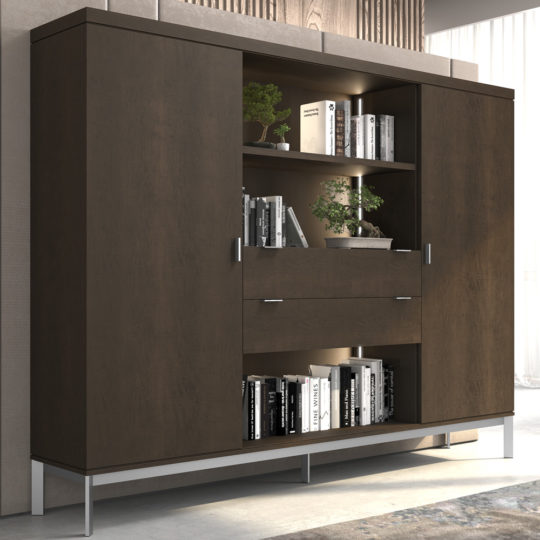
- Best of both (combination storage): The most versatile option, blending display and hidden sections within the same cabinetry. Showcase curated objects, art, or books in open or glass-fronted areas while keeping paperwork, cables, and office supplies discreetly tucked away. This approach balances personality with practicality and is particularly effective in bespoke units where proportions, finishes, and lighting can be tailored to your exact needs.
-
Modern Lacquered Sideboard£5,310.00
-
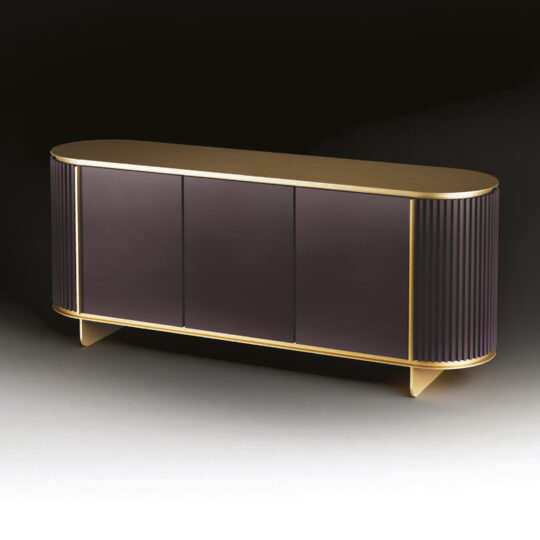
Contemporary Lacquered Curved Sideboard£9,960.00
-
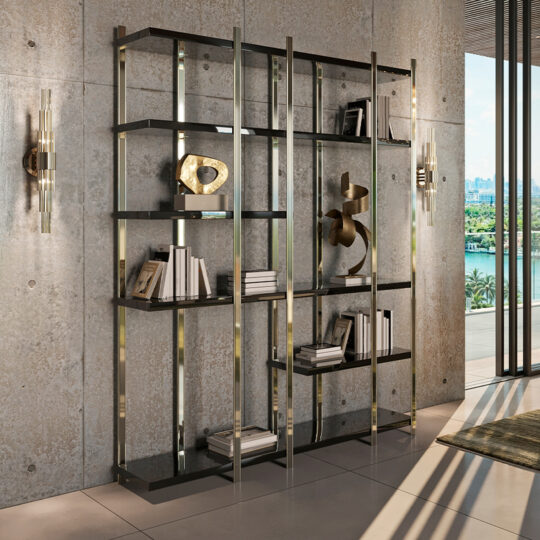
Large Modern Open Bookcase£7,770.00
-
Modern Wooden Bookcase£7,619.00
Style and finish
Storage units present a key opportunity to reinforce your design direction:
- Lacquered, veneered, or solid wood finishes create richness and depth—fluted or ribbed fronts are especially popular for architectural interest
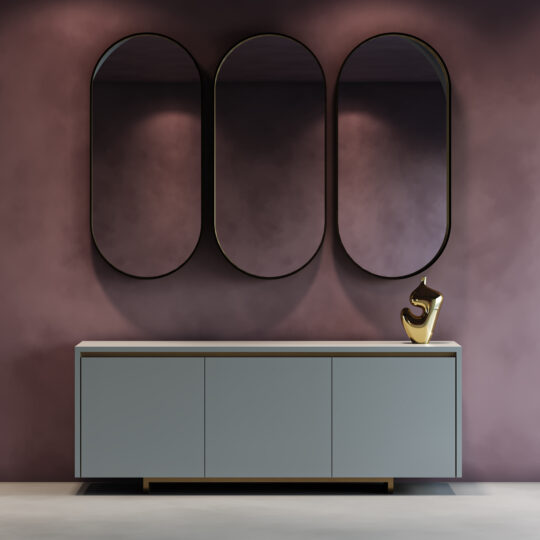
- Matte lacquer or painted cabinetry offers a more minimal, contemporary look
- Metal detailing (brass trims, steel frames) can add sophistication or an industrial edge
Built-in vs freestanding
- Bespoke built-ins maximise storage by working around alcoves, sloped ceilings, or awkward wall proportions. They also integrate seamlessly into the architecture of the room.
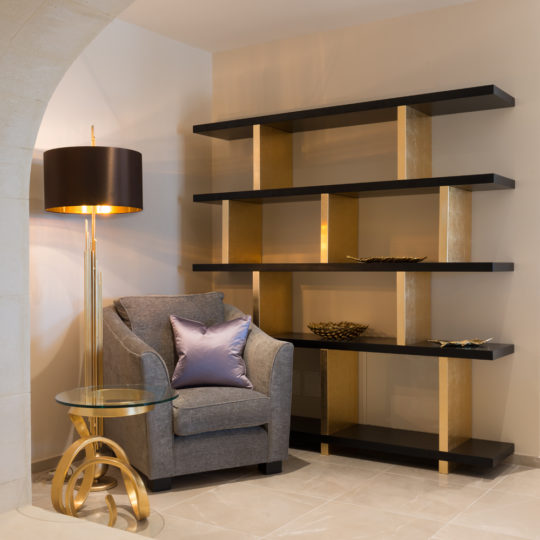
- Freestanding pieces give more flexibility and personality—statement bookcases, sculptural consoles, or high-end cabinets can double as focal points in the room.
Low vs. full-height storage
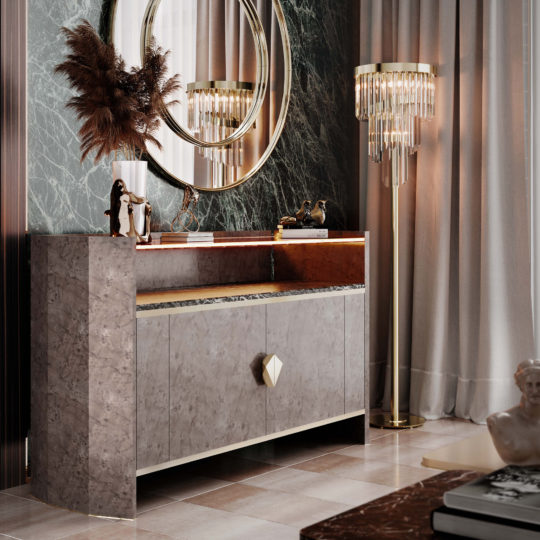
- Low-level storage (sideboards, consoles, cabinets, bookcases): Keeps the room feeling open and leaves space for artwork, mirrors, or lighting above. Works well in multifunctional or shared offices where you don’t want a wall of cabinetry dominating the space.
- Full-height storage (bookcases, built-ins, wall units): Maximises storage in smaller offices and creates an architectural presence. Offers ample room for files, reference books, and styled display zones, but must be scaled carefully to avoid overwhelming the room.
-
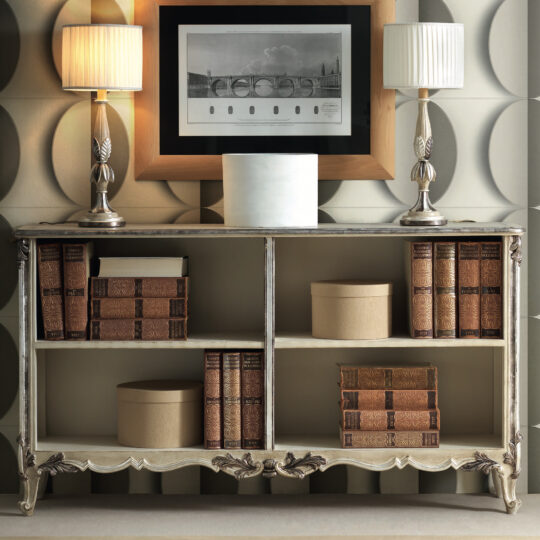
Rococo Inspired Low Bookcase£5,216.00
-
Modern Veneer 2 Door Cabinet£12,444.00
-
Bespoke Luxury Gold Leaf Display Shelves£19,311.00
Handles and hardware
Hardware is the finishing touch that elevates the look and tactile experience of office storage. Options range from inset grooves for a sleek finish to brass, leather-wrapped, or textured pulls that add a crafted, luxurious detail. Consider the mechanisms: soft-close hinges and drawers create a smooth, seamless feel, while leather- or suede-lined interiors elevate everyday functionality into something indulgent. These are the elements you’ll interact with most, so investing in superior craftsmanship ensures your storage is not only practical but a pleasure to use.
Custom or bespoke solutions
- Custom storage: Tailored to your exact room dimensions, making the most of awkward alcoves, sloping ceilings, or under-window space. Allows finishes to perfectly match your desk and overall scheme.
- Bespoke furniture: Designed around your specific working habits—drawer depths that fit your files, hidden compartments for tech, integrated lighting, or pull-out printer shelves. Not only practical, but also an opportunity to make storage a design feature in its own right.
Integration and customisation
Consider incorporating lighting into shelving or display cabinets—LED strips under shelves can highlight books or objects while adding ambience. Custom cabinetry also ensures you get exactly the storage you need, from the depth of drawers to the spacing of shelves.
Flooring
Selecting the right flooring for your home office is just as important as choosing the desk or chair—it needs to balance style, comfort, and durability. Home offices are high-use spaces, and the wrong flooring can quickly show wear from rolling chairs, heavy furniture, or daily foot traffic.
Key considerations include:
- Durability: Office chairs often have casters or wheels for ease of moving around. These chair wheels can scratch or dent softer surfaces like hardwood or vinyl. Opt for hard-wearing materials such as engineered wood, laminate, or luxury vinyl tile (LVT) that can withstand movement and weight.
- Protection: Use discreet chair mats or area rugs under desks and chairs to prevent scuffing while adding texture and warmth. For dual-purpose spaces, or where you have fold-away desks, this can prevent uneven wear and tare in specific places and promote longevity of your flooring.
- Acoustics: Hard flooring can amplify sound, while carpet or luxury rugs help absorb noise. Useful if you take frequent calls or video meetings. Especially in multifunctional spaces such as the living room or dining room, where people may be coming in and out.
- Maintenance: Offices should be easy to keep clean. Choose finishes that resist marks from shoes, coffee spills, or chairs.
- Aesthetic fit: Flooring should harmonise with the overall design scheme of your office, whether you want the grounded luxury of dark timber, the sleek professionalism of stone, or the comfort of a soft wool rug layered over wood.
Expert tip: A common mistake is overlooking how flooring transitions into adjacent spaces or under doorways, which can cause uneven thresholds or awkward breaks in flow. Consulting with an interior designer ensures your office flooring not only looks beautiful but is practical, resilient, and tailored to your specific working style. Whilst they may not be experts in all types of flooring, they often have an extensive network of suppliers they can source from.
Crafting a lighting scheme luxury home office
The right lighting not only enhances the atmosphere in your home office but also directly impacts productivity, focus, and comfort. Get it right, and your office becomes a refined, energising space that supports both creativity and efficiency. Get it wrong, and the room risks being either overly stark and clinical—or frustratingly dim, making even simple tasks a strain.
Layering your lighting is key. Combine ambient lighting for overall illumination, task lighting for focused work, and accent lighting to highlight architectural details or design features. This multi-dimensional approach ensures your office feels as practical as it is luxurious, whether you’re working late into the evening, meeting clients in person, or hosting video calls.
Ceiling lights
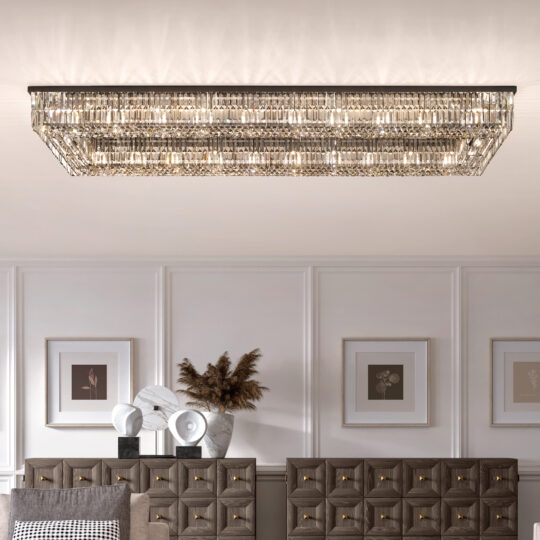
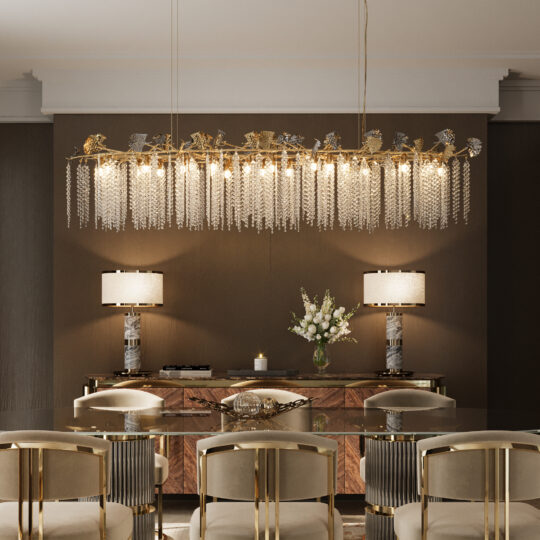
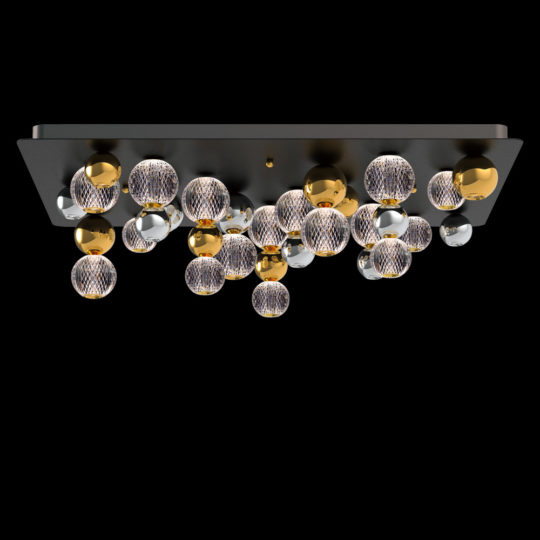
Ceiling lights form the primary lighting source in most offices, shaping the overall character of the room. A statement chandelier or pendant can provide elegance and gravitas, while a sleek modern fixture delivers clean, even light without distraction.
-
Rectangular Smoked Cut Crystal Ceiling LightPrice range: £10,100.00 through £19,950.00
Recessed lighting works well for a minimalist, contemporary home office—providing brightness without competing visually with feature pieces like a bespoke desk or statement artwork.
When selecting ceiling lighting, consider ceiling height and proportions. Fixtures hung too low can intrude on sightlines, while lights placed too high may leave the space feeling under-lit. Dimmable options are especially valuable, allowing you to shift from bright morning productivity to softer evening ambience, or to account for changes in natural light throughout the day.
-
Contemporary Leaf Chandelier With Crystal Drops£6,842.04
-
Luxury Gold And Silver Ceiling Light Cluster£3,886.00
-
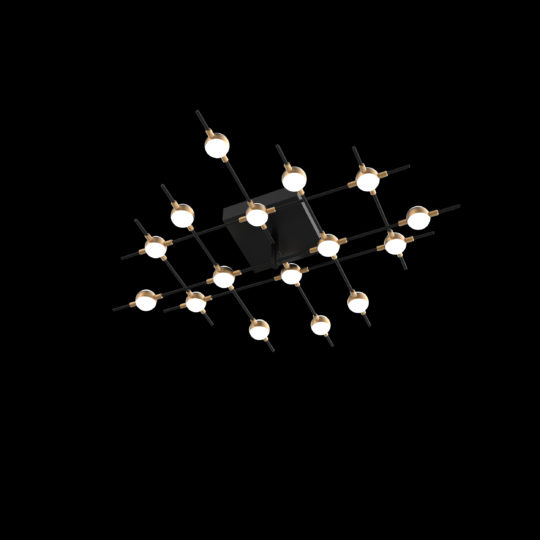
Luxury Black And Gold 16 Flush Ceiling Light£1,364.00
-
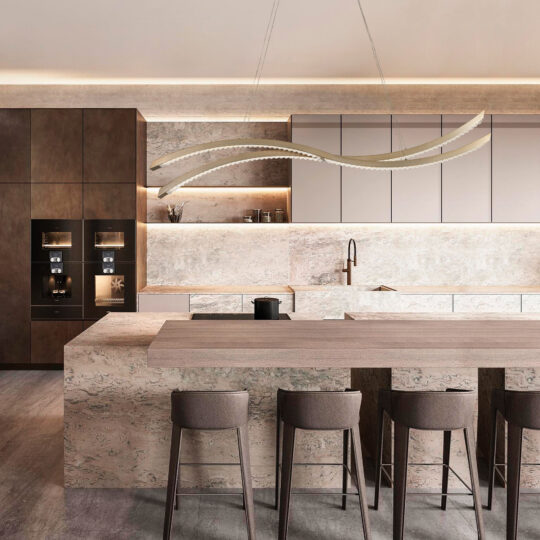
Contemporary Linear ChandelierPrice range: £4,330.00 through £5,915.00
Task and functional lighting
Task lighting is essential for reading, writing, or screen-based work. A luxury desk lamp, whether in polished brass, marble, or sculptural, combines function with style, ensuring even illumination without glare.
Expert tip: Always place a table or desk light on the opposite side to your writing hand, so you do not cast shadows over what you’re working on.
-
Crystal Rock Table Lamp£1,113.96
-
Modern Twisted Bronze Table Lamp£2,145.96
-
Modern Round Table Lamp£1,197.00
-
Designer Black Marquina Marble Table Lamp£1,802.00
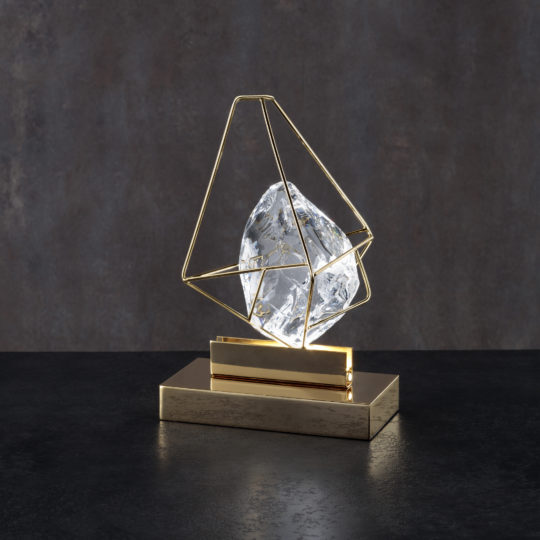
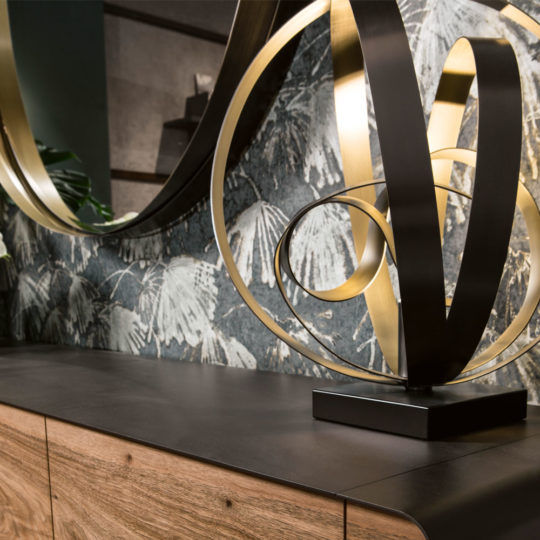
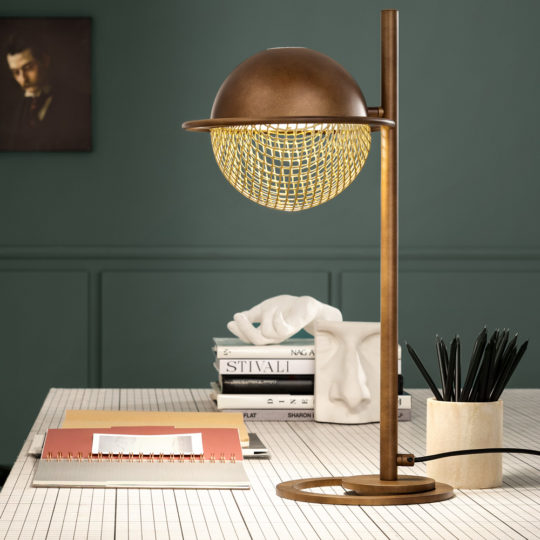
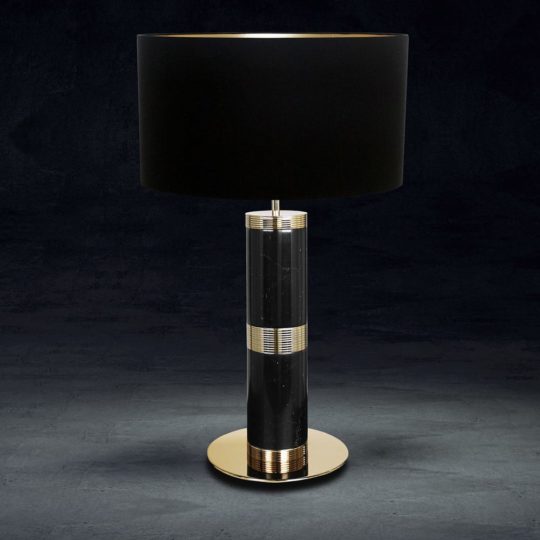
Table lamps are dependent on the amount of desk space you have spare. If desk space is at a premium, floor lamps or wall-mounted task lights may be more suitable. Adjustable-arm lamps or wall-mounted task lights can bring flexibility while saving surface space.
-
Contemporary Burnished Brass Wall Light£1,690.00
-
Gold Plated Designer Modern Floor Lamp£2,769.96
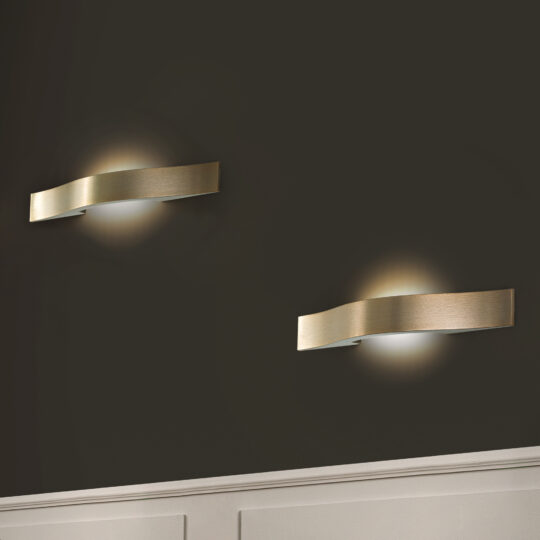
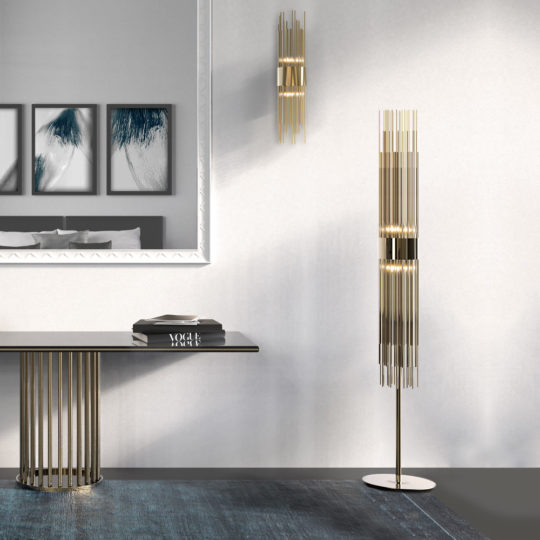
For those incorporating standing desks, ensure lighting adapts to both seated and standing positions. Avoid harsh downlighting directly over monitors, as this can create glare and eye strain. Instead, aim for directional light sources that can be angled and softened.
-
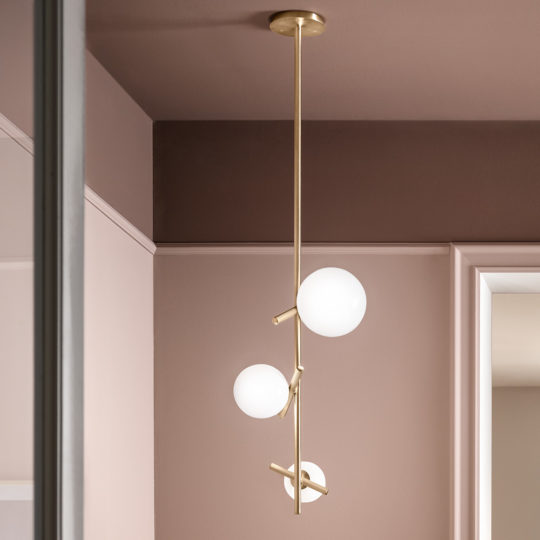
Contemporary Murano Glass Vertical Pendant Light£2,100.00
-
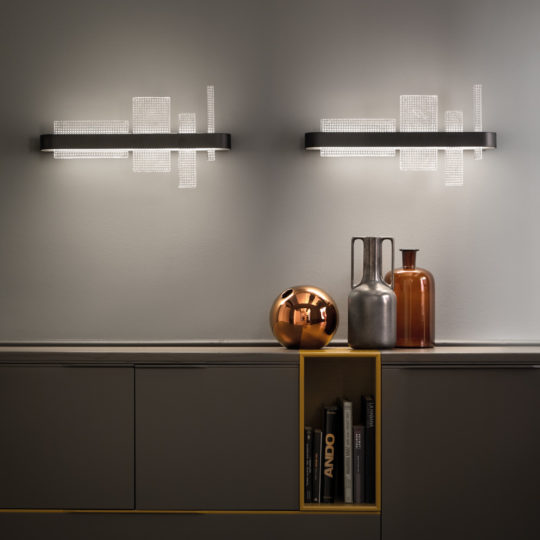
Modern Large Glass Wall LightPrice range: £1,255.00 through £1,793.00
Accent Lighting
Accent lighting introduces warmth, depth, and personality to your office. Wall lights or picture lights are perfect for illuminating artwork, while LED strips can highlight bespoke shelving, cabinetry, mirrors or architectural details. A softly backlit bookcase or curated display brings elegance while subtly increasing usable light. Or even an LED room divider can create a feeling of zones within a room without blocking off the space too heavily.
Expert tip: Accent lighting also plays a vital role in video conferencing—carefully positioned wall lights or concealed LEDs can provide flattering, even illumination that avoids harsh shadows. It can also create glare, so careful consideration of placement aligned with your desk and screen position is vital.
-
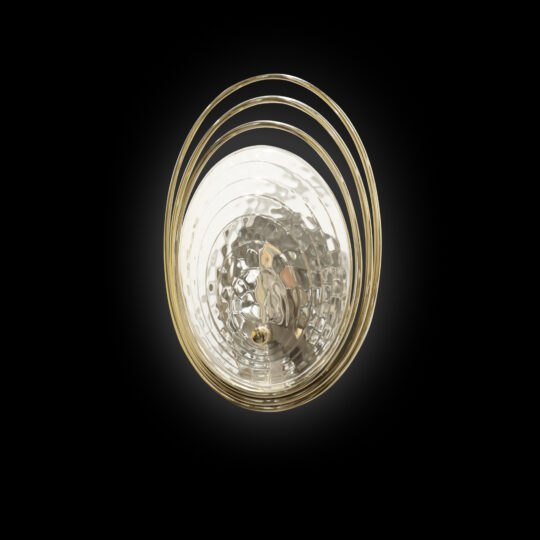
Modern Wall Light Inspired By The Sea£572.00
-
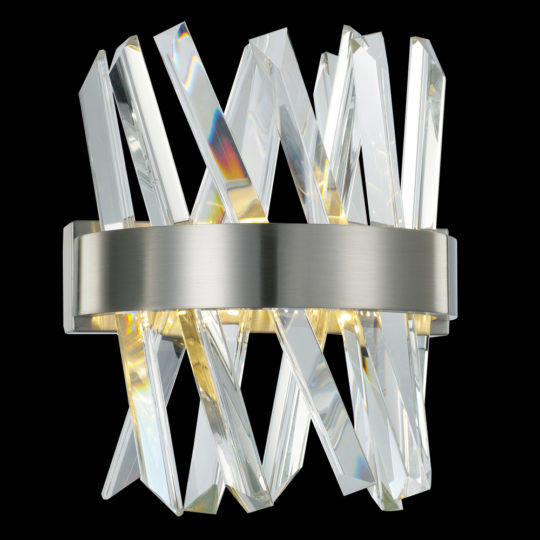
Exclusive Crystal Nickel Wall Light£573.00
-
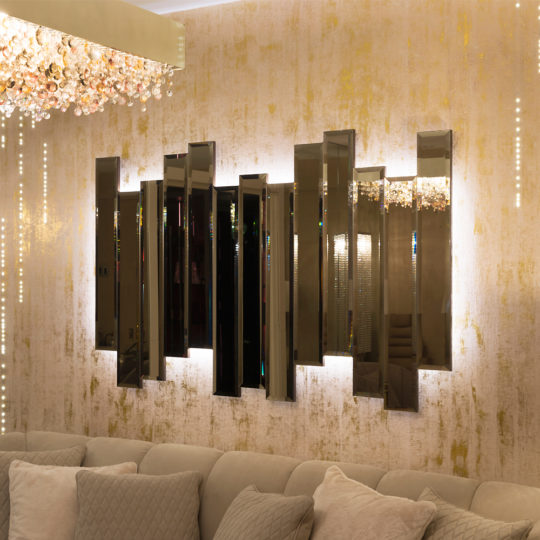
Exclusive Backlit Bronze MirrorPrice range: £6,734.00 through £7,128.00
Creating the perfect lighting scheme
Never rely on a single light source. A layered lighting scheme—blending ceiling fixtures, task lighting, and accent illumination—creates a versatile and luxurious office environment. Always test your lighting both in daylight and after dark, as natural and artificial light can completely alter the mood of your workspace. Check out our comprehensive guide to creating a luxury lighting design plan for even more tips and ideas.
Selecting furniture for a dedicated meeting space
If your home office will regularly host clients, colleagues, or partners, the furniture you choose sets the tone—not just for productivity, but for the impression your guests take away.
- Tables:
- Formal meetings: A round or oval table promotes openness and collaboration, while a rectangular design offers structure and authority.
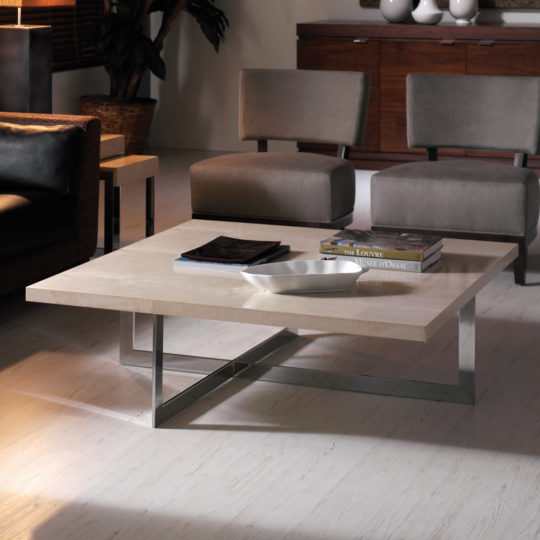
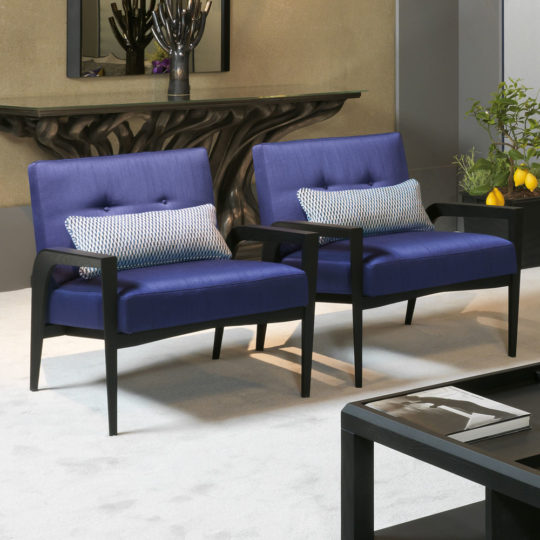
- Informal meetings: A pair of armchairs or a sofa with a central coffee table can create a lounge-like zone that encourages more relaxed, creative discussions.
- Seating:
- For formal setups, opt for ergonomically designed guest chairs upholstered in leather, velvet, or performance fabrics—comfortable enough for longer sessions, but polished enough to convey professionalism.
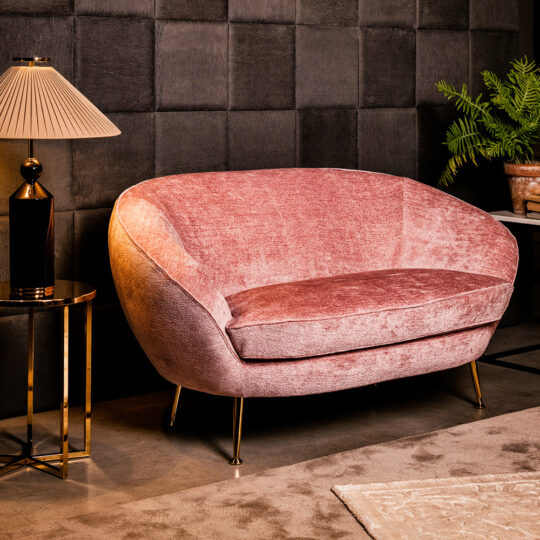
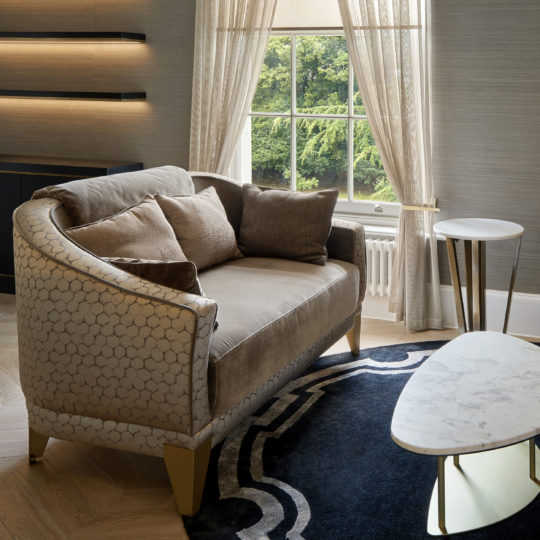
- For informal or creative zones, consider deep armchairs or a low-profile sofa paired with side tables. These support laptops, notebooks, or drinks without requiring guests to perch at your desk.
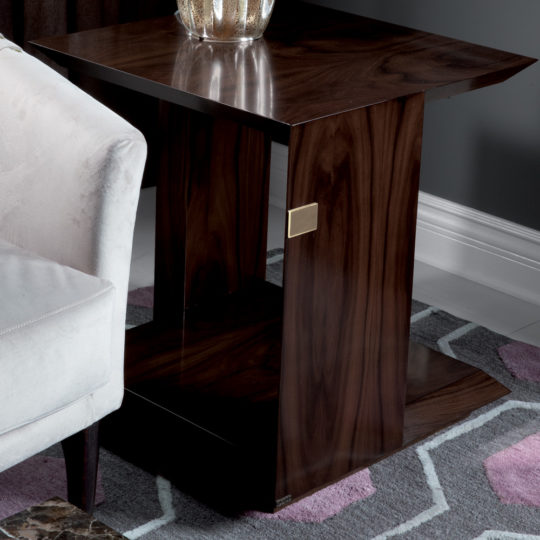
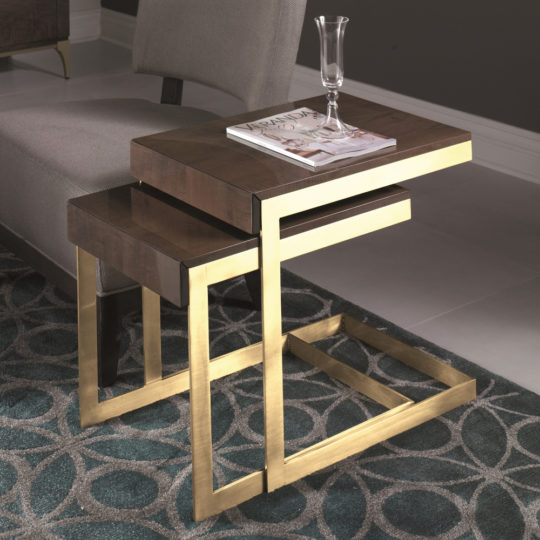
- Side tables: Small but crucial, side tables anchor a lounge-style seating area and add both convenience and refinement. Choose designs with durable surfaces (stone, glass, or lacquer) that can handle drinks and tech, or select nesting tables for added flexibility.
- Flexibility: In multi-use offices, modular furniture works well—foldaway tables, stackable chairs, or lightweight accent chairs can adapt the room for both boardroom-style and casual brainstorming.
- Technology integration: Ensure the meeting zone is near power sources or fitted with integrated charging points. If video conferencing or presenting is part of your routine, place furniture so everyone has clear visibility of a wall-mounted screen.
- Atmosphere: A luxury rug beneath the meeting area, paired with layered lighting (pendants, sconces, or floor lamps), helps to zone the space. Lighting can also distinguish between a more formal setting and a softer, lounge-like feel.
Expert tip: Think of your meeting space as a reflection of your brand. Bespoke furniture allows you to tailor both proportions and finishes—whether you want a structured boardroom presence or a relaxed coffee-lounge vibe that encourages open conversation.
-
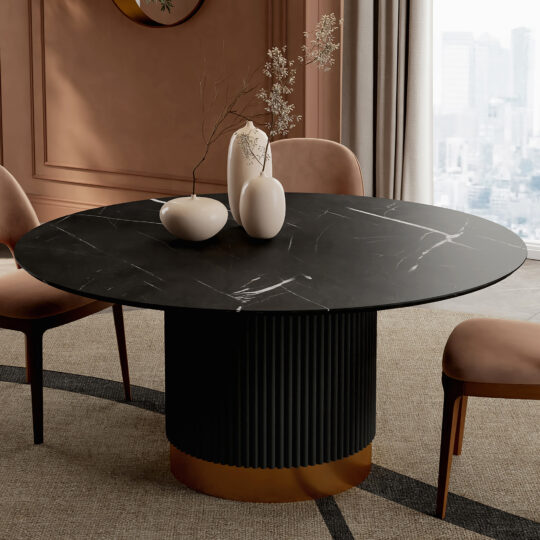
Round Contemporary Stone Effect Dining Table£6,065.00
-
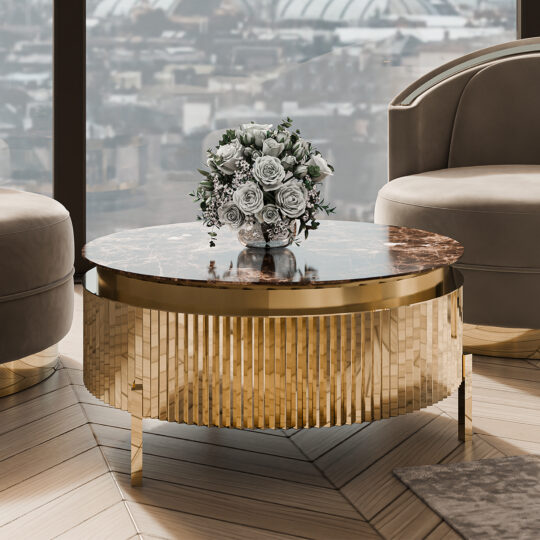
Round Modern Marble Coffee Table£5,298.00
-
Luxury Round Ebony Veneer Dining Table Set£35,067.00
-
Contemporary Winged Occasional Armchair£3,770.04
-
Small Contemporary Designer Sofa£8,457.00
-
Luxury Small Two-Tone Sofa£14,480.04
-
Modern Elegant Side Table£2,123.00
-
Modern Occasional Table Nest£3,149.00
-
Contemporary Wooden Coffee Table£3,402.00
-
Elegant Occasional Armchair£4,420.00
-
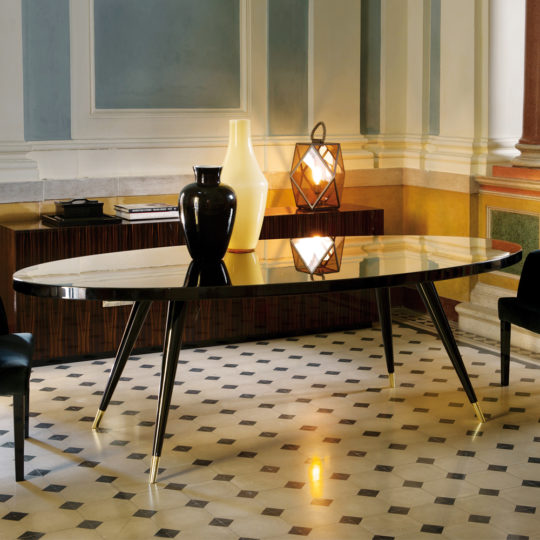
Contemporary Italian Designer Oval Dining Table£11,967.00
Wall finishes:
The walls in your home office do more than frame the space—they influence focus, productivity, and the overall atmosphere of your working environment. Because they cover such a large surface area, wall finishes should be chosen with both functionality and aesthetics in mind.
Consider how your chosen colours, textures, and patterns support the way you want to feel in your office. Do you need calm and focus, or energy and creativity? Also think about what will sit behind you on video calls—artwork, shelving, or decorative panels—and how your wall finishes can create a polished, professional backdrop that reflects your style.
For offices that double as multi-functional spaces, finishes should be durable and adaptable. Textured wall panels or upholstered sections can soften acoustics, while sophisticated paint schemes or luxury wallpapers add depth and refinement.
-
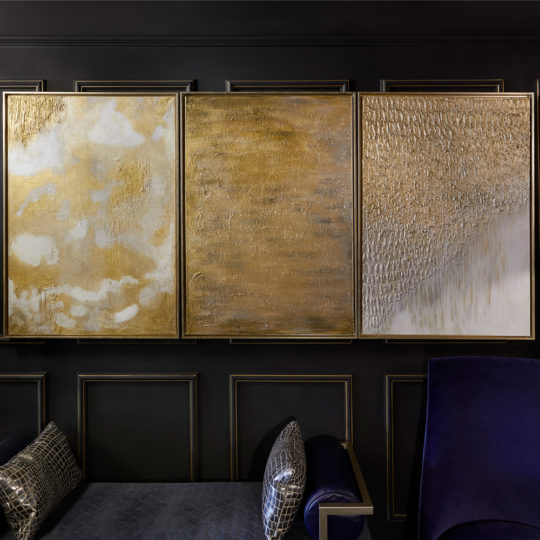
Set of Original Abstract Paintings£5,930.00
Mirrors:
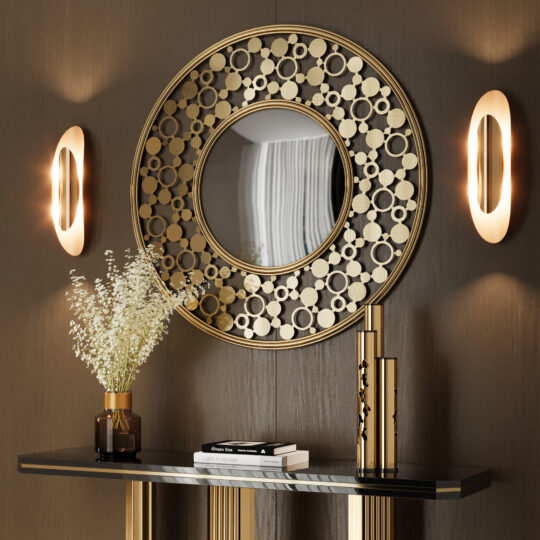
A carefully chosen mirror can completely transform your home office, enhancing both its sense of light and spatial depth. Positioned opposite a window, a mirror will bounce natural light across the room, reducing the need for artificial lighting and creating a more uplifting working environment.
-
Modern Round Convex Mirror£5,368.00
-
Nautical Round Mirror£2,850.00
-
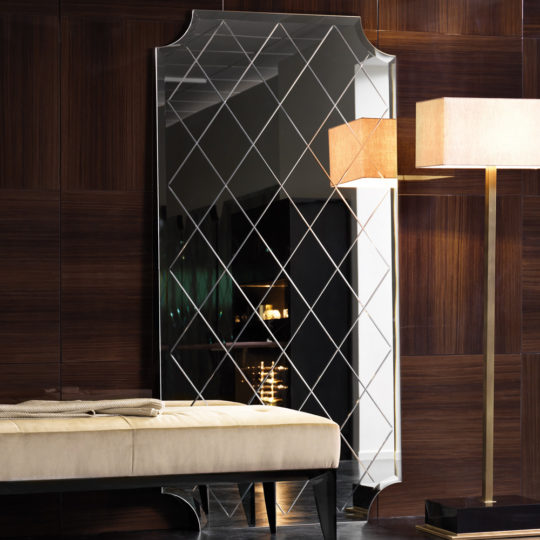
Contemporary Large Floor Standing Engraved MirrorPrice range: £1,990.00 through £2,776.00

Luxury home office design: the finishing touches
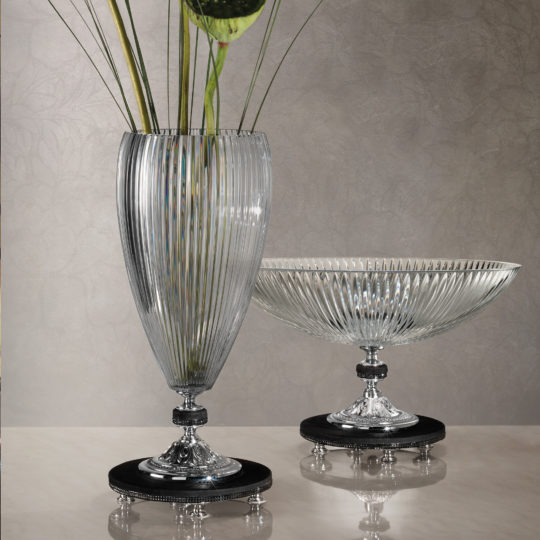
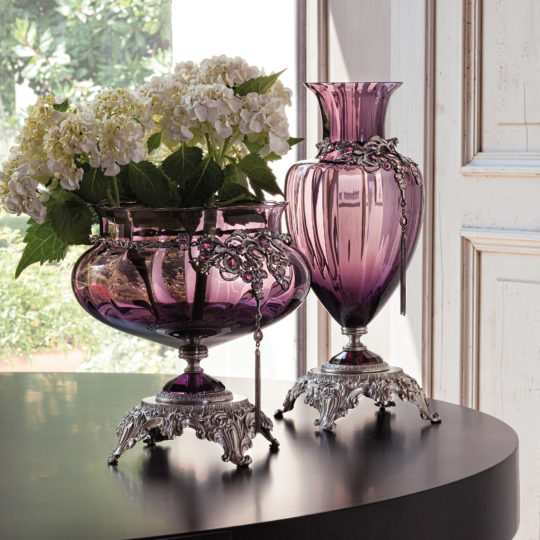
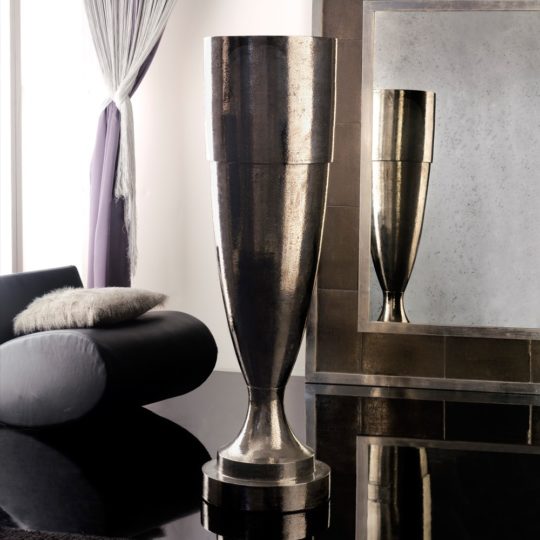
Once the main elements of your home office design—desk, chair, and storage—are thoughtfully curated, it’s the finishing touches that define its character and elevate your working experience. Consider a curated set of stationery, a decorative tray to keep essentials organised, or a sculptural object that adds visual interest. Artworks, objets d’art, or framed photographs bring the personal touch, while a scented candle can create a calming atmosphere.
Don’t underestimate the impact of greenery. Plants not only enhance the aesthetics of your office but also support wellbeing by improving air quality, reducing stress, and fostering focus. From a tall statement plant in the corner to small succulents on a shelf, or a beautiful bouquet in a vase, greenery introduces a sense of life and balance into the space.
-
Cut Crystal Centrepiece and VasePrice range: £2,021.00 through £2,704.00
-
Ornate Jewelled Glass Centrepiece and VasePrice range: £1,473.00 through £1,555.00
-
Exclusive Large Platinum Plated Majolica Vase£6,178.00
It’s these final layers of detail—polished, personal, and purposeful—that ensure your home office isn’t just a place to work, but a sanctuary where creativity, focus, and luxury meet.
Why invest in an interior designer?
An interior designer does far more than enhance aesthetics—they help you create a space that works seamlessly for your lifestyle, while avoiding costly mistakes and saving you time and stress. From keeping your project on schedule and within budget to curating luxury furniture or designing bespoke home office furniture crafted just for you. At Juliettes Interiors, we have a trusted network of master craftsmen and artisans, plus more than two decades of expertise in luxury furniture design. We deliver home office designs that are unique, functional, and tailored to the way you work, such as this award-winning interior design project for a luxury home office apartment in London
Working with our award-winning interior designers will take your home office design journey to new heights. Our expert team combines creativity, technical expertise, and a refined eye for detail to help shape and perfect your vision. Through a collaborative and bespoke process, we ensure your office is not only tailored to your preferences but also exceeds expectations in comfort, ergonomics, and style.
Luxury home office interior design, London, UK
If you’re ready to explore the possibilities for your home office, book an appointment at our London design studio. Or give us a call and speak with one of our designers to discuss your vision, or email us, details below. Let’s create something spectacular together!